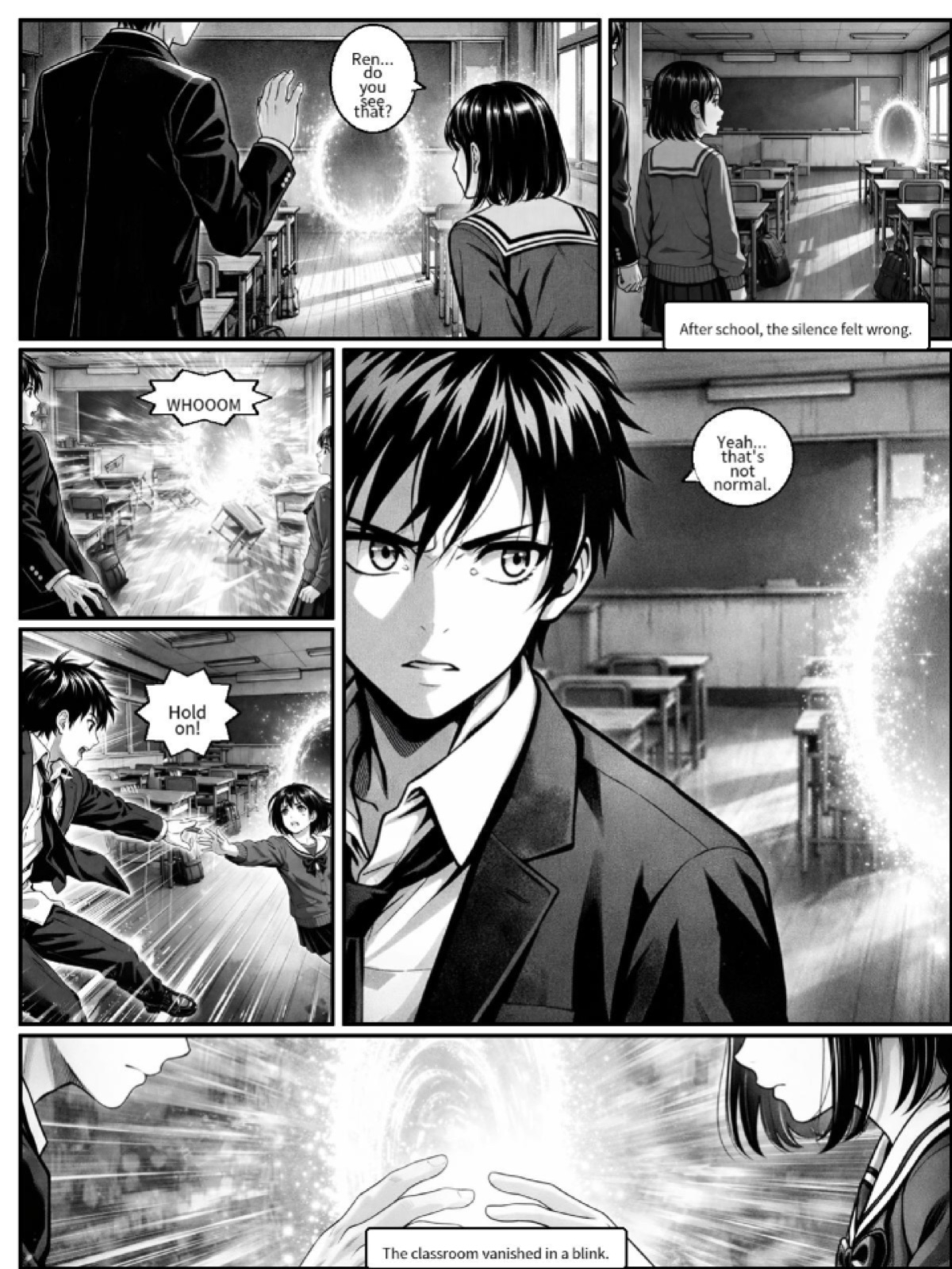
Every AI comic demo you have ever scrolled past has the same dirty secret: it can draw one gorgeous panel, but it cannot draw a page. Ask a diffusion model for “page 3” and you get a soup of overlapping frames, characters whose faces drift between panels, and speech bubbles slapped over someone’s eyes. A team out of the University of Tokyo just published a fix that treats the comics page like the structured object it actually is — and the numbers are not subtle.
The Story
MangaFlow is an end-to-end agentic framework for turning a written story into a complete, multi-page manga. It comes from Muyao Wang, Yanhao Chen, Lixin Xiu and Hideki Nakayama (University of Tokyo) with Zeke Xie (HKUST Guangzhou), and it dropped on arXiv on May 27, 2026.
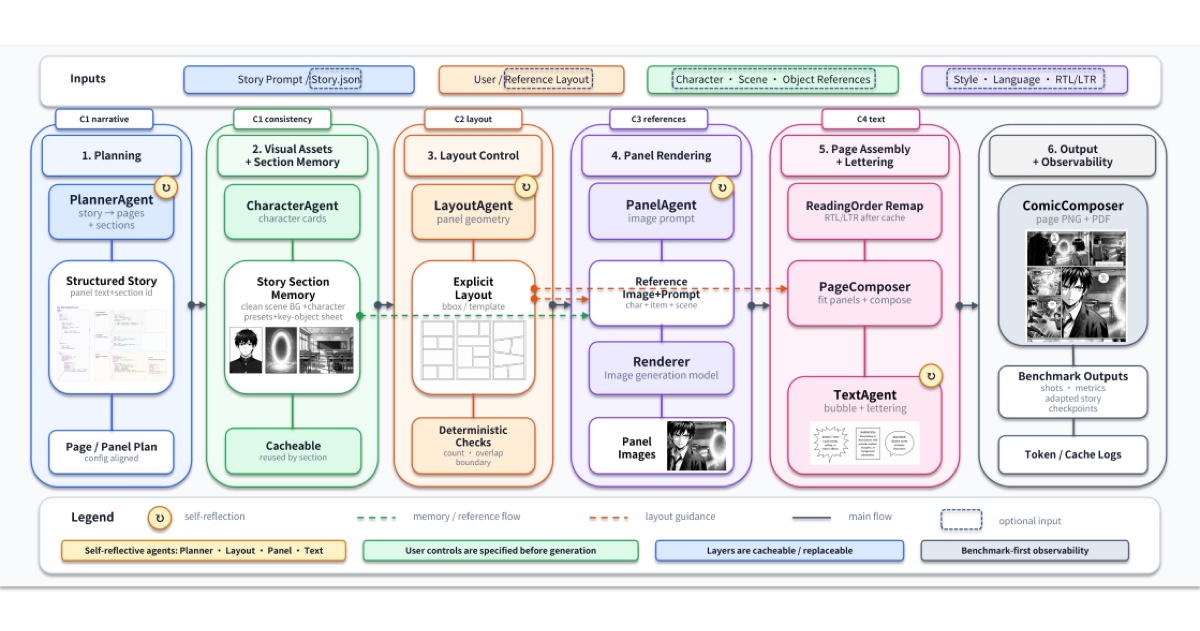
The core insight is almost philosophical: manga layout is not decoration, it is narrative. A wide establishing panel, a tight reaction beat, the rhythm of how your eye jumps across the page — that is the storytelling. Most generators treat layout as an accidental by-product of a single big image. MangaFlow flips that and makes layout a first-class, editable variable that gets decided before a single pixel is rendered.
Instead of one monolithic model, the pipeline is a relay of six cooperating agents. A Planning Agent breaks the story into pages and panels. A Story Section Memory keeps character cards, scenes and objects on file so the same protagonist actually looks like himself ten pages later. A Layout Agent proposes — or accepts from you — the panel geometry. A Panel Agent writes the per-panel prompt with full story context, a Renderer draws it with reference conditioning, and a Text/Lettering Agent places bubbles and narration without covering faces. Several of those agents even self-reflect and re-check their own output before passing it down the line.
Why You Should Care
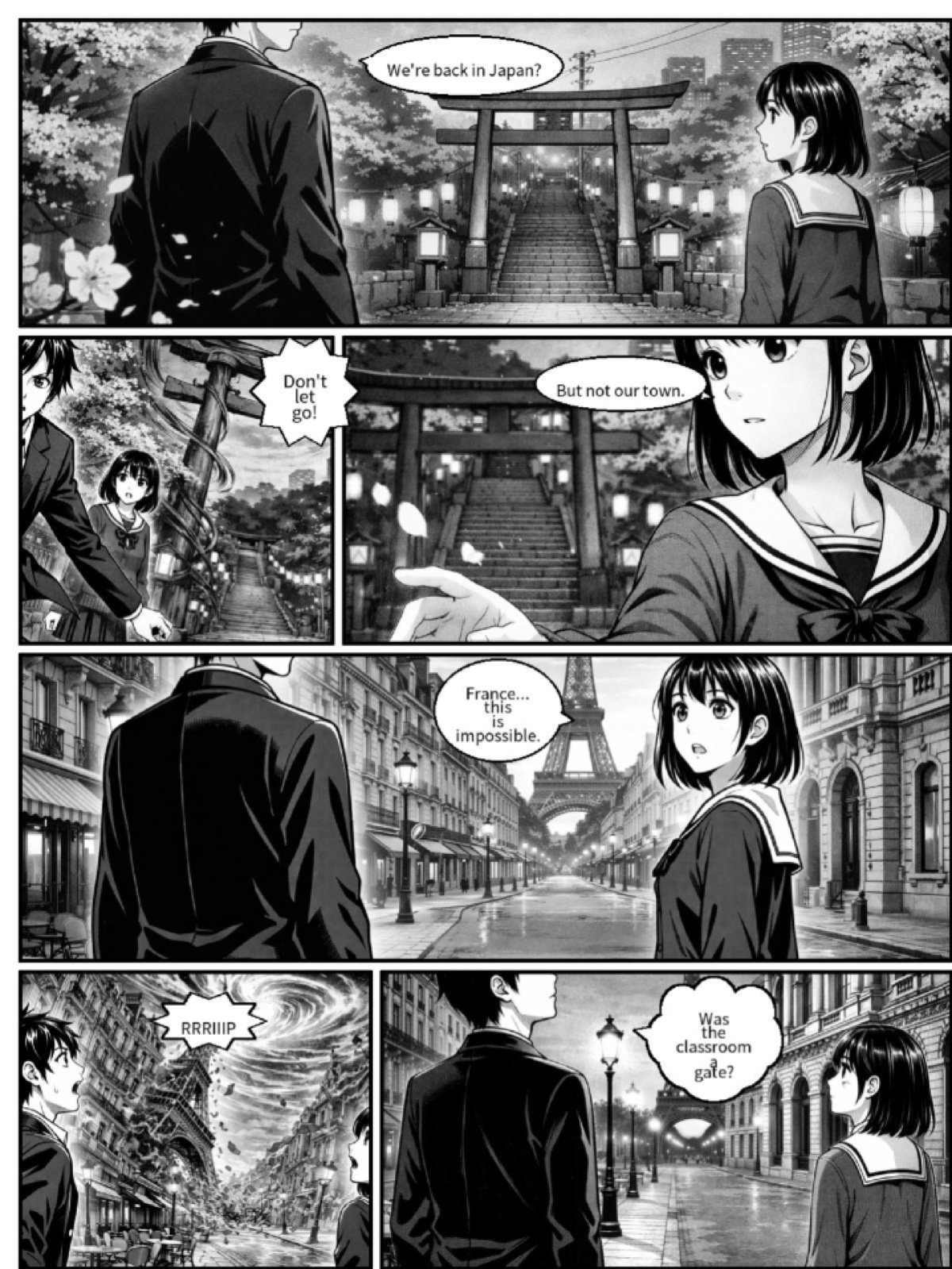
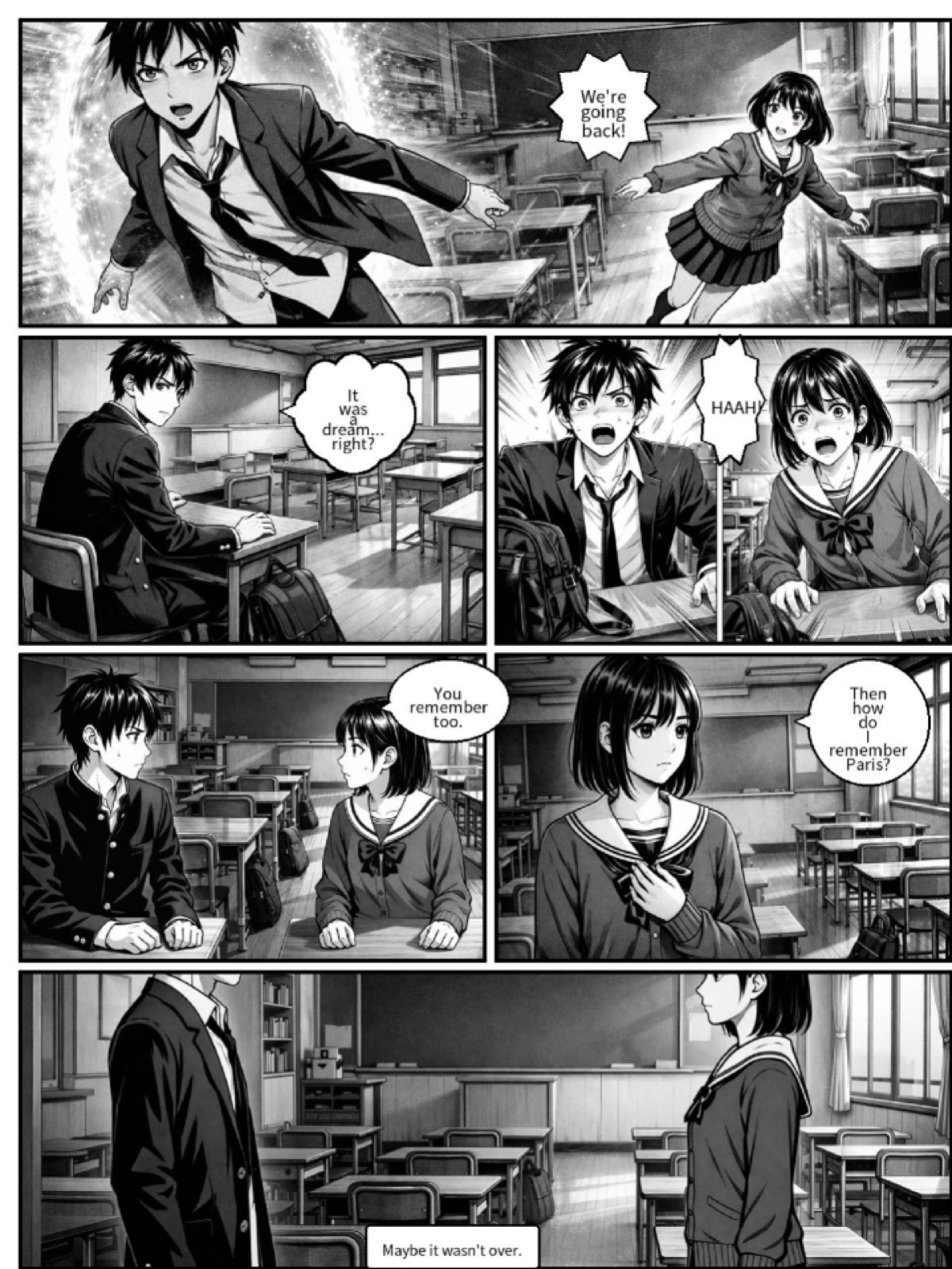
Because the gap between “cool panel” and “publishable page” is exactly where every AI comics tool dies, and MangaFlow’s benchmarks land right on that gap. On the team’s MangaGen-MetaBench — an extension of ViStoryBench with 80 stories and manga-specific metrics — direct page-generation methods hit the requested panel count only 28–44% of the time. MangaFlow hits it 100%. Layout IoU (does the page actually match the intended structure?) goes from ~41–43% to 100%. Bubble placement scores 97.4%, while the direct baselines essentially can’t produce reliable dialogue at all.
That last point matters more than the raw geometry. A comic without legible, non-face-covering dialogue is just an illustration set. By making lettering its own accountable stage, MangaFlow crosses from “AI that draws manga-ish images” into “AI that produces something you could actually read.”
The ablations are the honest part. Story Section Memory bumps character-consistency (CIDS 0.619 vs 0.582 without it), and the layout self-reflection loop drops panel overlap to 0.62%. None of these are magic single-shot tricks — they are the boring, structural decisions that separate a tech demo from a workflow.
Try It / Follow Them
MangaFlow is a research paper, not a download — there is no public code or hosted demo yet, so for now it is a read rather than a run. Grab the full paper and figures on arXiv (2605.28173), and watch Hideki Nakayama’s lab at the University of Tokyo and Zeke Xie’s group at HKUST (Guangzhou) for a release. If you want to chase the same structural ideas today, the renderer slot is model-agnostic — a ComfyUI graph wiring a planning LLM to FLUX.1 Kontext (today’s go-to for character-consistent sequential art) with an explicit layout pass is the closest DIY approximation.
IK3D Lab Take
We have spent months watching AI eat 3D one geometry problem at a time, and MangaFlow is the same lesson in a different medium: the win wasn’t a better image model, it was refusing to treat the page as one image. Decompose the artifact into its real structural variables — layout, memory, lettering — give each an accountable agent, and let them check each other. That recipe just took manga from “uncanny panel generator” to “100% layout accuracy.” It is also a blueprint you can feel coming for storyboards, comic books, even shot lists. No code today, but this is the architecture the next wave of BD tools will quietly copy. Watch this one.