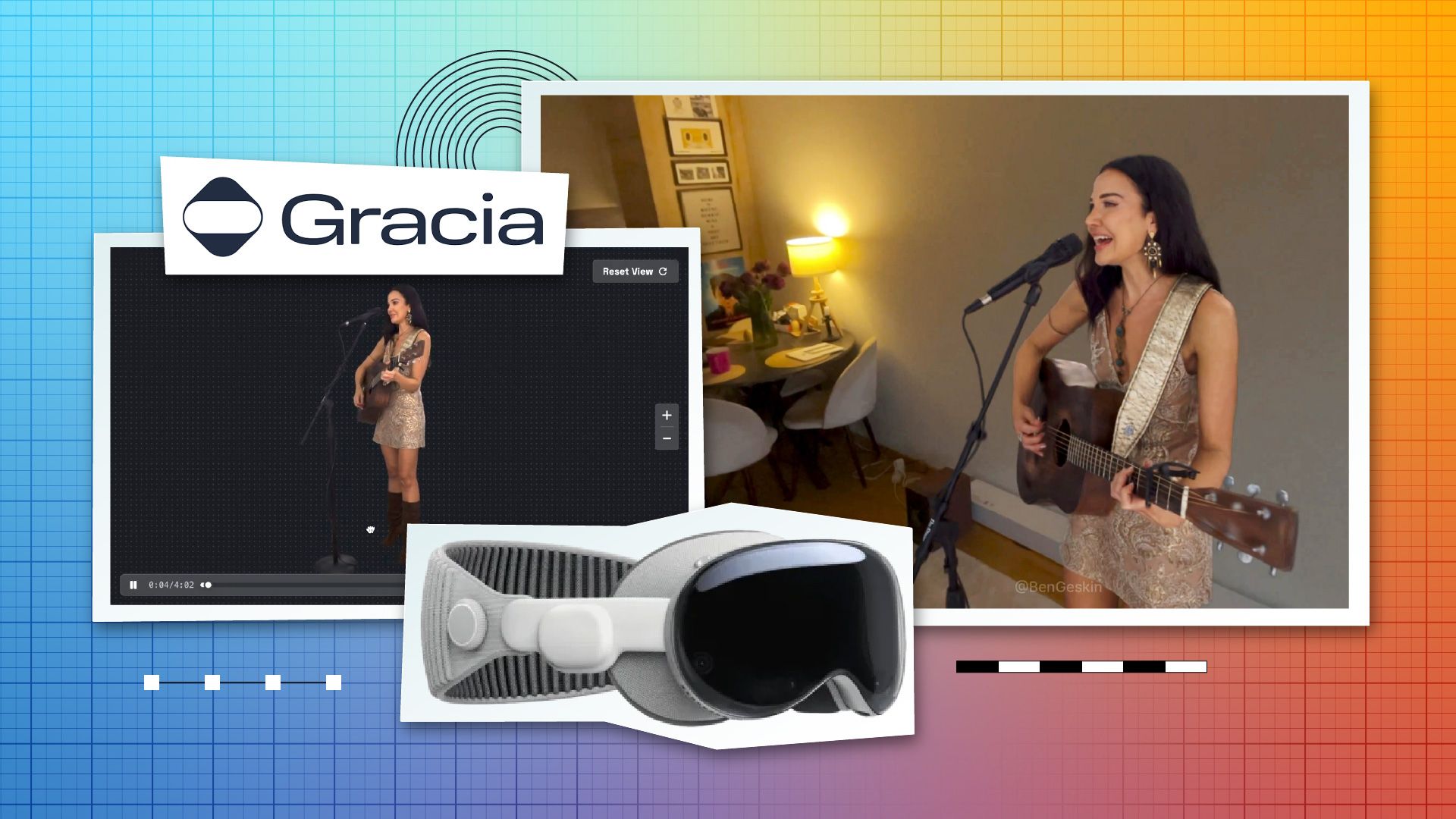
Put on a Vision Pro, open a free app, and a real human walks into your living room — life-sized, lit like the day they were captured, and you can step around them to see their back. No download. No 40 GB asset. It streams over the same Wi-Fi you use for Netflix. On June 19, 2026, Gracia shipped exactly that: a 4DGS viewer for Apple Vision Pro that streams moving Gaussian splats the way YouTube streams video.
The Story
We’ve covered a lot of Gaussian splatting in the Lab, but almost all of it has been static — a frozen scene you walk through. The hard, unsolved problem has always been the fourth dimension: time. A moving splat scene (4DGS) is essentially a fresh point cloud of a hundred-thousand-plus colored, semi-transparent blobs per frame. At 30 fps that’s a firehose of data. For years the only way to watch one was to download the whole thing and pray your GPU survived.
Gracia’s breakthrough is unglamorous and brilliant: they applied video-codec thinking to splats. Instead of shipping every splat for every frame, the stream sends keyframes plus motion-delta updates — encoding only the splats that actually change between frames, and decoding it all in the browser with WebGPU. It’s H.264 logic, reborn for radiance fields.
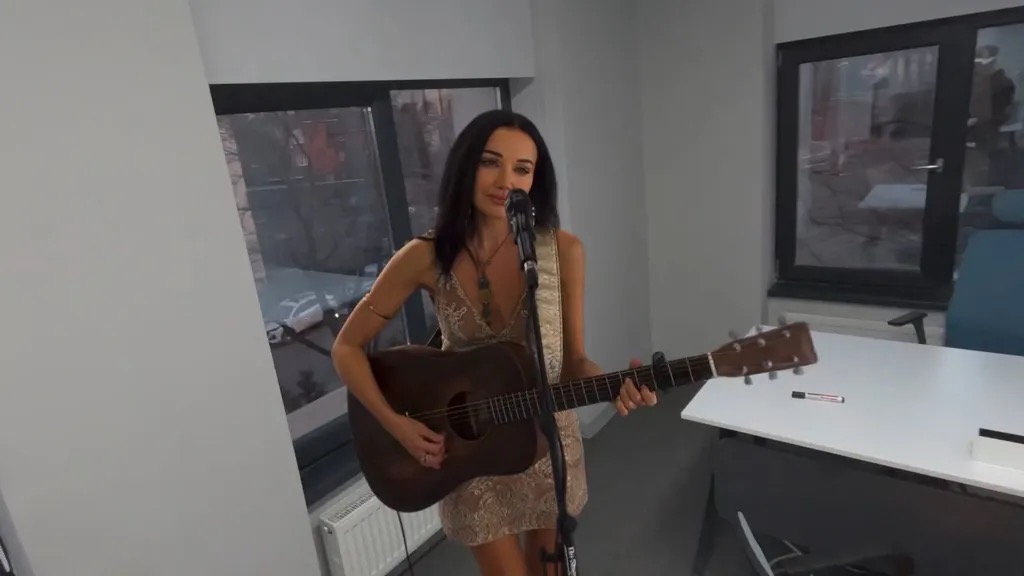
The numbers are the headline. High-quality playback runs at roughly 120,000 splats per frame over a 75 Mbps connection. A lighter mode drops to ~15,000 splats at 17 Mbps for weaker networks. Crucially, there’s no hard file-size ceiling — which is why Gracia can stream a four-minute musician performance with spatial audio, not just a six-second loop. The app ships with 25+ photorealistic captures and requires visionOS 26.4 on an M2 Vision Pro or newer.
Why You Should Care
This is the moment volumetric video stops being a tech demo and starts being distribution. Think about what “streamable” unlocks: a dancer, a teacher, a surgeon, a band — captured once, then dropped into anyone’s physical space on demand, viewable from any angle they choose. That’s a fundamentally different medium from a flat 360 video where the camera position is locked to wherever the rig stood.
For 3D and creative folks, the interesting part is the pipeline economics. Capture still isn’t cheap — professional 4DGS needs roughly 60 shutter-synced, genlocked cameras in a sphere, and Gracia’s processing runs around $800/minute on top of studio time. But the delivery just became trivial. The expensive part moved from “getting it onto the headset” to “shooting it well” — and that’s a problem creators already know how to solve.
Try It / Follow Them
- Vision Pro: grab Gracia: 4DGS viewer free on the App Store (visionOS 26.4+, M2 or newer) and walk around the 25+ bundled captures.
- No headset? Gracia also streams via WebXR in the browser and has standalone builds on Quest 3 and Pico 4.
- Dig deeper: the platform and store live at gracia.ai; Radiance Fields has the technical write-up.
IK3D Lab Take
The clever move here isn’t the rendering — it’s treating a radiance field like a codec problem. Every splatting story we’ve run lately has been about making scenes bigger, sharper, or more relightable. Gracia asked a different question: how do you ship a living one? Borrowing keyframe-plus-delta compression from 30 years of video engineering is the kind of lateral thinking that turns a lab curiosity into a consumer app overnight.
The honest caveat: capture is still a $15K-studio affair, and 75 Mbps for the good stuff isn’t universal. This is the “expensive cameras, easy playback” phase — exactly where photogrammetry sat a decade ago. But the trajectory is unmistakable. Static splats taught headsets to render the world. 4DGS streaming is teaching them to render people, live. We’d bet the first genuinely jaw-dropping “they’re really in the room with me” moment for most people arrives through a stream exactly like this one.