Here is the dirty secret of the Gaussian Splatting boom: we got incredibly good at capturing the world, and stayed embarrassingly bad at showing it. Every splat ends up the same way — dropped into a viewer, an orbit camera, a play button, and the same awkward shrug: “so… spin it around?” The format that re-invented 3D capture has been stuck inside a glorified turntable. Olli Huttunen, the Finnish creative who has been quietly teaching half the 3DGS community on YouTube, just dropped the fix. It is called Dioramix, and it treats splats the way they should have been treated from day one — as scenes you tell stories with.
The Story
Olli Huttunen is not a stranger on this blog and not a stranger in the splatting world. Fifteen years inside Finnish museums building video installations, then a one-man studio (Top Upy) doing motion graphics and 3D scanning — the guy was running photogrammetry, then NeRFs, then 3DGS basically the week each of them shipped. His YouTube channel is one of the cleanest entry points into the technique that exists. Anyone who has typed “gaussian splatting tutorial” into the search bar in the last two years has seen his face.

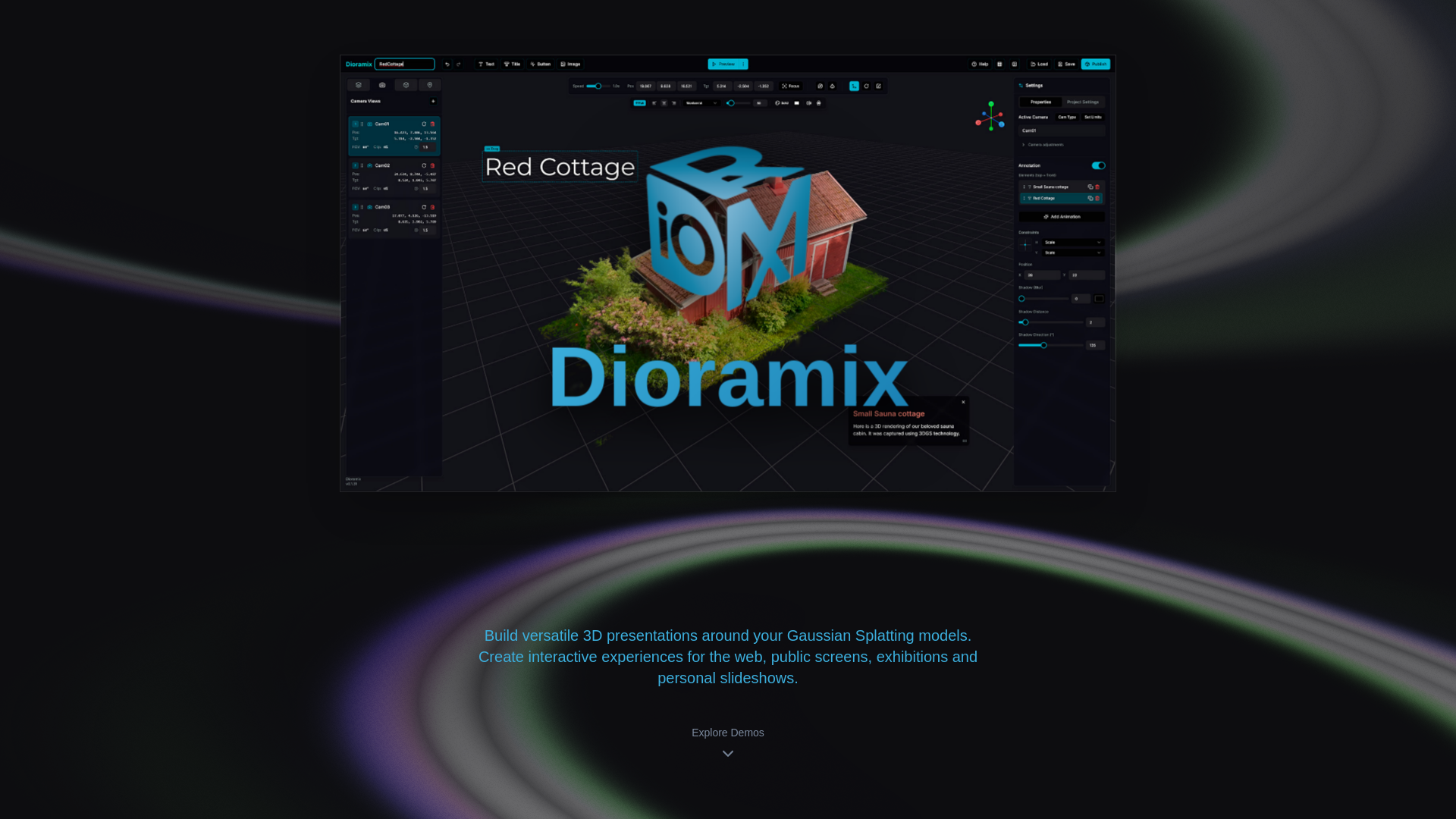
Announced April 28 over at Radiance Fields, Dioramix comes out of an obvious itch. Olli kept watching clients capture a beautiful Gaussian Splat — a workshop, a heritage site, a forensics scene, a real-estate property — and then have absolutely nowhere to put it that wasn’t a glorified GLB on a black background. His own quote nails it: “The hardest part of showing someone a Gaussian Splat has never been capturing it, it’s been conveying what it means.”
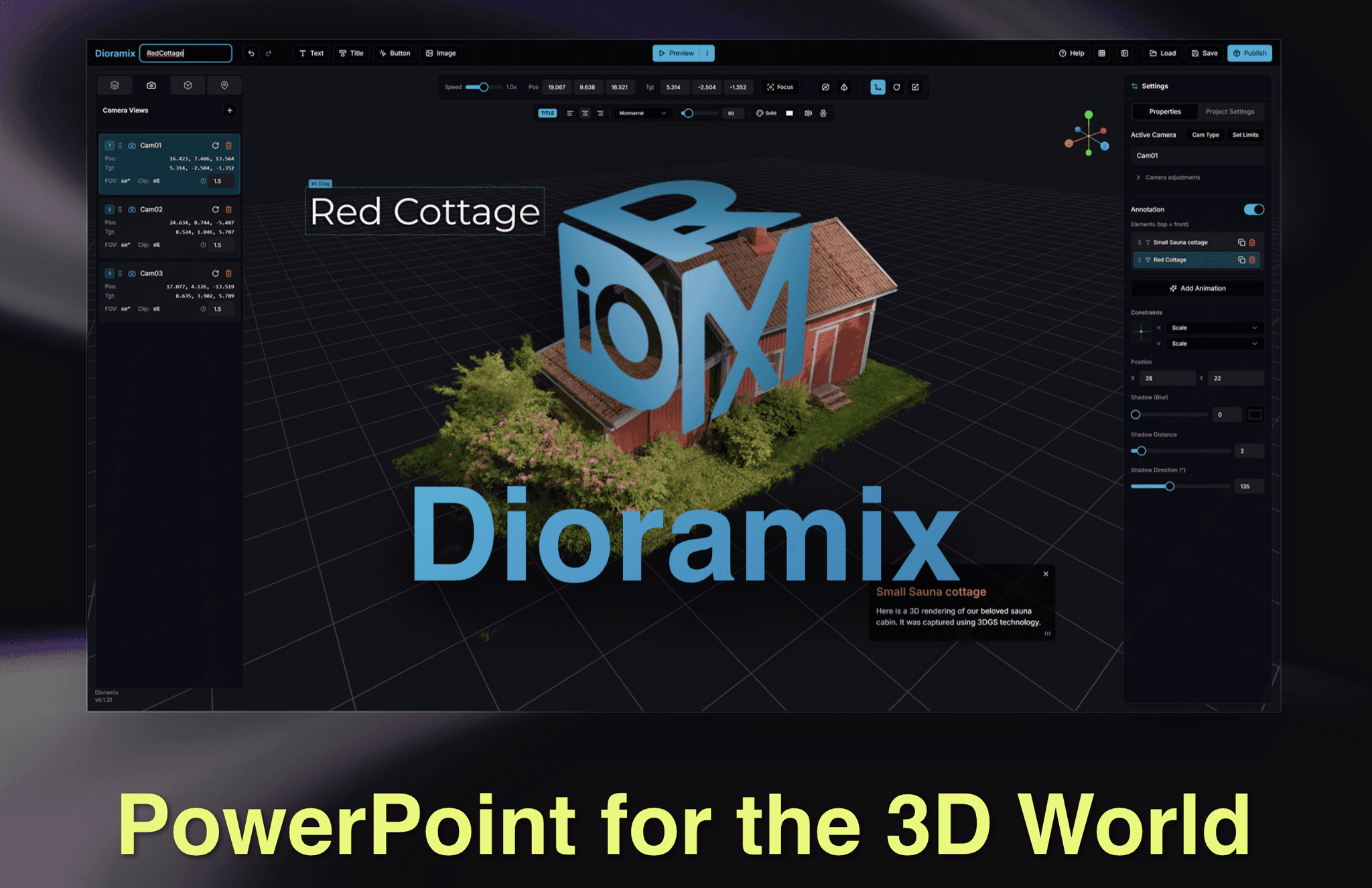
So he built the missing layer himself. Dioramix is a browser-based editor built on BabylonJS with a WebGPU backend. You drop in PLY, SPZ, SOG, GLB/GLTF, or OBJ files. You frame camera positions and save them as slides. You hang annotations, hotspots, buttons, image carousels, embedded videos, and PDFs onto the scene. Buttons can rotate the camera, switch to a completely different splat, fire an iframe, or jump out to a URL. Multiple splats can live inside a single presentation. Nothing leaves your machine — Olli built it local-first, no server upload, and the whole thing exports as a self-contained ZIP of HTML and assets that runs offline. Think of it as Keynote for radiance fields, except the slides are 3D and the audience can wander between them.
Why You Should Care
Because the entire industrial argument for Gaussian Splatting falls apart at the last mile. We covered Cesium streaming 110 million splats like map tiles, KIRI Engine turning splats into clean meshes, NanoGS bringing Nanite-style LOD to Unreal — and yet the average client deliverable is still “here is a link, drag with your mouse, good luck.” Capture pipelines have lapped presentation pipelines so hard it is embarrassing. Dioramix is the first tool that takes the deliverable problem seriously without forcing you into a game engine.
- Museums and heritage: guided tours through a scanned site with text panels, audio, and document overlays — and zero data leaving the curator’s laptop. This was Olli’s day job for fifteen years; he knows exactly what that audience needs.
- Real estate and architecture: a scanned property with hotspots that pop floor plans, finishes, and rental docs, exported as a single ZIP a sales agent can mail.
- Forensics and engineering: a crime-scene splat (yes, this is a real Olli use case) with annotated trajectories, evidence callouts, and chain-of-custody PDFs attached directly to the scene.
- Education: a T. rex skeleton you can navigate slide-by-slide, with each slide framing a different anatomical detail and embedded reference material.
And there is a deeper signal here. The 3DGS ecosystem just got the glTF KHR_gaussian_splatting and OpenUSD ratifications standardizing the format itself. Standards on the wire are great, but standards do not write the user-facing tools. Dioramix is what happens when an actual practitioner — not a billion-dollar lab, not a VC-backed startup, just one person who has been hand-holding the community on YouTube — sees the gap and ships the missing piece. It is the kind of project the splatting world has been quietly waiting for.
Try It / Follow Them
- Sandbox access: request a key at dioramix.eu — public beta is teased “for the near future.”
- Live demos: the T. rex walkthrough, the synthetic-city real-estate tour, and the ski-jumping complex are all on the site.
- Olli’s YouTube: @OlliHuttunen78 — the launch video and the long-running 3DGS tutorial series.
- Background listening: his episode on the View Dependent podcast on 3DGS best practices.
- The announcement post: Radiance Fields — Olli Huttunen Announces Dioramix.
IK3D Lab Take
This is exactly the right tool at exactly the right time, made by exactly the right person. The market was full of capture startups (Polycam, KIRI, Postshot, Splatica), infrastructure plays (Cesium, Niantic Spatial), and engine integrations (Unreal, Blender, Cinema 4D). Nobody was working on the boring, unsexy, absolutely critical last 10% — turning a splat into something a non-technical human can be walked through. A solo dev on the Finnish coast just shipped it, in a browser, offline-capable, framework-light. We are dead certain Dioramix is going to leak into client decks within weeks: museum tours, architectural walkthroughs, forensics reports, real-estate listings. If you ever have to hand off a splat to a human who is not you, you owe yourself a sandbox key. And if Olli wants to keep this solo and indie, more power to him — that is exactly the kind of tool the 3DGS scene needs more of, and exactly the kind of maker IK3D Lab roots for.
The era of “here is a splat, drag your mouse” is finally over. Welcome to the storytelling layer.