You point your camera at a thing on your desk. Twenty seconds later you are spinning a textured 3D model of it — and nothing ever left your machine. That is LocalMesh 2.0, and its big new trick is deceptively simple: it stops guessing the parts of the object it cannot see, and starts reading them from your other photos.
The Story
Image-to-3D has a dirty secret. One photo only shows you one side. Every single-image model on earth handles the hidden back the same way: it invents it. Sometimes the guess is great. Often it is mush.
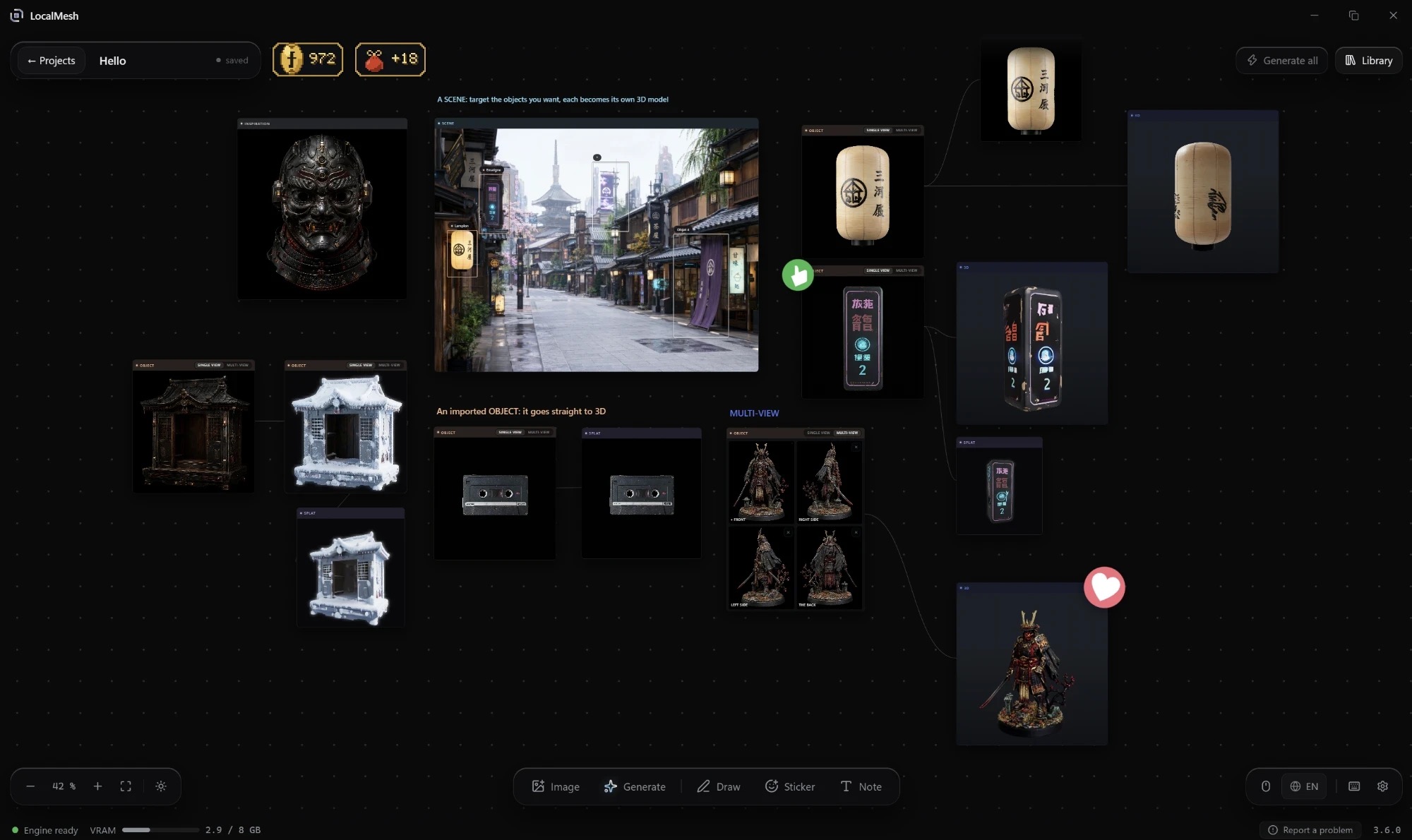
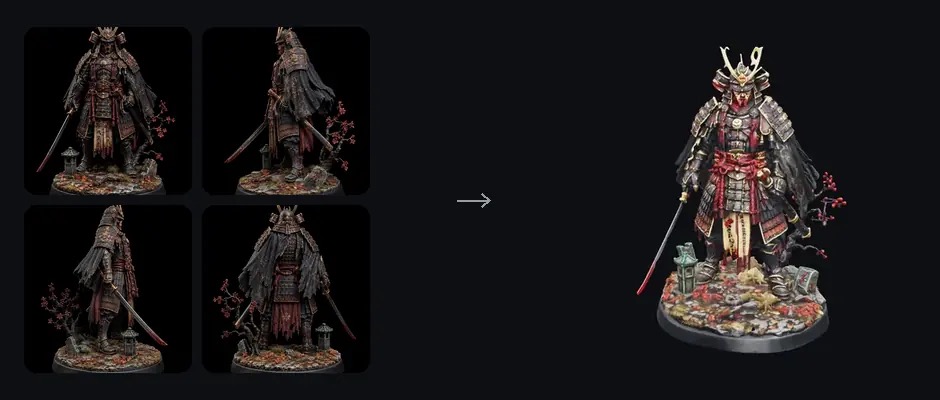
LocalMesh 2.0, a small Windows app by an independent maker, attacks that head-on. Its headline feature is multi-view fusion. Instead of one photo, you drop in the front, the sides, and the back. In the maker’s own words, “the four photographs are fused on a single grid, and the back of the object is built from your photograph of the back.” The invisible surface is no longer dreamed up — it is measured from what you actually shot.
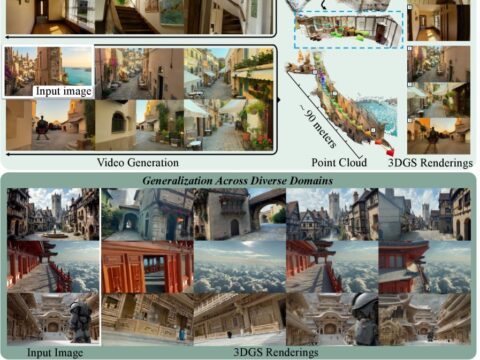
Under the hood, the splat comes from TripoSplat — Tripo’s MIT-licensed latent flow model that pairs a DINOv3 encoder with a FLUX.2 VAE and runs 30 sampling steps to spit out 262,144 Gaussians. From there LocalMesh does something clever and old-school: it plants 60 virtual cameras on a golden-angle sphere, renders a depth map from each through gsplat, carves away the empty air every ray passes through, and fuses all 60 depth maps into a 768³ TSDF volume. A Poisson solver seals the surface, then decimation and atlas baking hand you a clean, textured mesh — about 288,000 triangles.
The whole run stays under 7.3 GB of VRAM. That is roughly 60 seconds on an RTX 5090, about two minutes on a humble RTX 4060. There is also a built-in Image Studio that isolates the subject, straightens the perspective and fixes the lighting in around 20 seconds — on your GPU, not a server. And if you have no photo at all, you can type a text prompt instead.
Why You Should Care
Two reasons, and neither is the hype word “AI.”
- It is genuinely offline. The models download once (~27 GB). After that, images, meshes and files never leave your machine. You can work on a closed network, under an NDA, on a plane. For studios that legally cannot upload client assets to a cloud generator, that is not a nice-to-have — it is the whole ballgame.
- Measured beats invented. Multi-view fusion is the quiet fix that single-image tools have been avoiding. If you care about the back of the object actually matching reality, shooting three or four angles finally pays off.
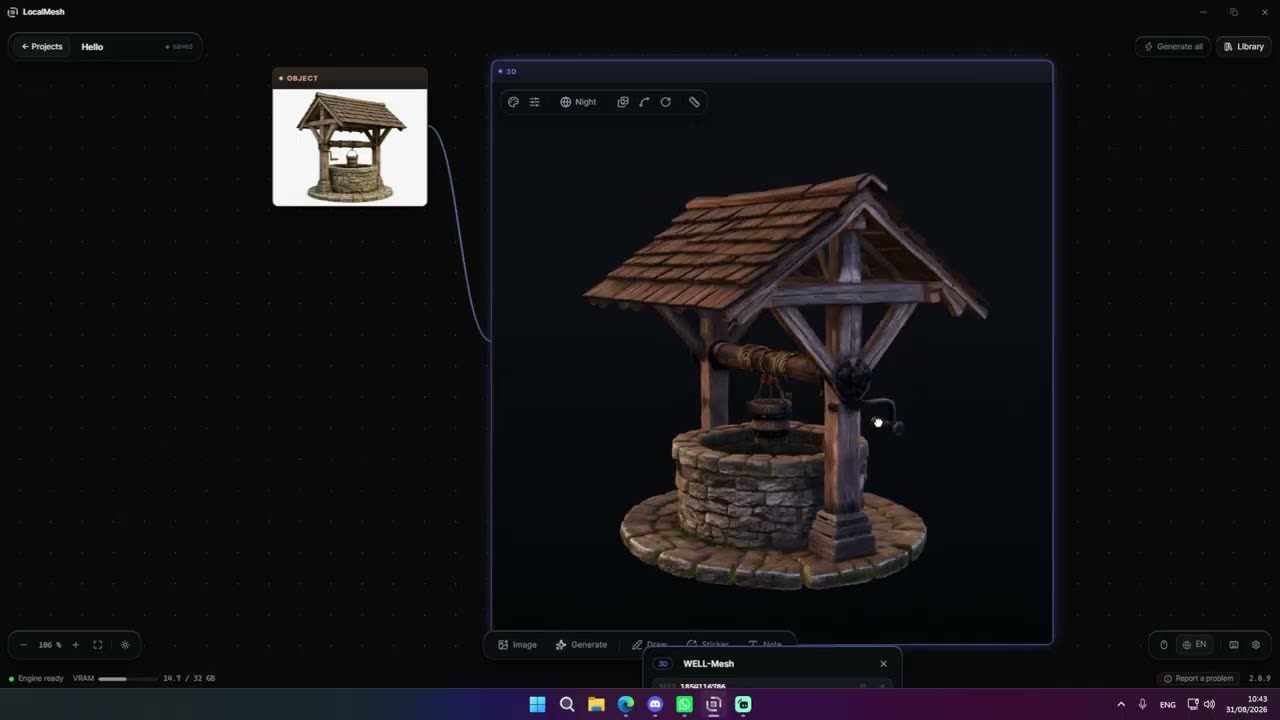
Exports are the ones you actually use: OBJ and GLB for meshes, PLY for splats. Drop the GLB straight into Blender, Unity or Unreal. No node graph to wire, no CUDA install ritual, no account.
Try It / Follow Them
- Site & download: local-mesh.com — Windows 10/11, NVIDIA GPU with 8 GB VRAM recommended.
- Price: 14 days free, then a single $39 payment. The key is perpetual — unlimited generations, commercial use, one machine at a time. A year of updates is included; another year is $39 if you want it.
- The engine: TripoSplat, the MIT-licensed model doing the heavy lifting.
- News source: spotted on Radiance Fields, the splat/NeRF newsroom worth a bookmark.
Note the fine print, because it is honest: this is Windows-only and NVIDIA-only. No Mac, no AMD, no cloud fallback. That is the price of running everything locally.
IK3D Lab Take
We have covered TripoSplat the model. LocalMesh 2.0 is the more interesting story: a one-person app that wraps a research-grade pipeline in something a working artist can actually use, priced like a plugin, and — crucially — never phones home. The multi-view fusion is the tell. Everyone else is racing to make the invented back prettier; LocalMesh just decided you should photograph it. That is the unglamorous, correct answer, and it is exactly the kind of pragmatic move the flashy cloud generators keep skipping. At $39 with a two-week trial, there is no reason not to feed it four photos of something on your desk and see the back of the object come out right for once.