
Every world model we have covered could draw you a place. None of them could let you hear it. Helix World, from Noiz AI and HKUST, is the first real-time world model that generates the picture and the spatial sound as one thing. Walk toward a fountain and the water gets louder. Turn your head and the sound turns with you.
The Story
You give Helix World a single starting image. Then you steer: WASD to move the camera, arrow keys to look around. The model generates the next short chunk of video, about 1.3 seconds at a time, and it generates the matching stereo audio in the same step. The sound field is tied to the camera. When you turn, the soundstage rotates with you.
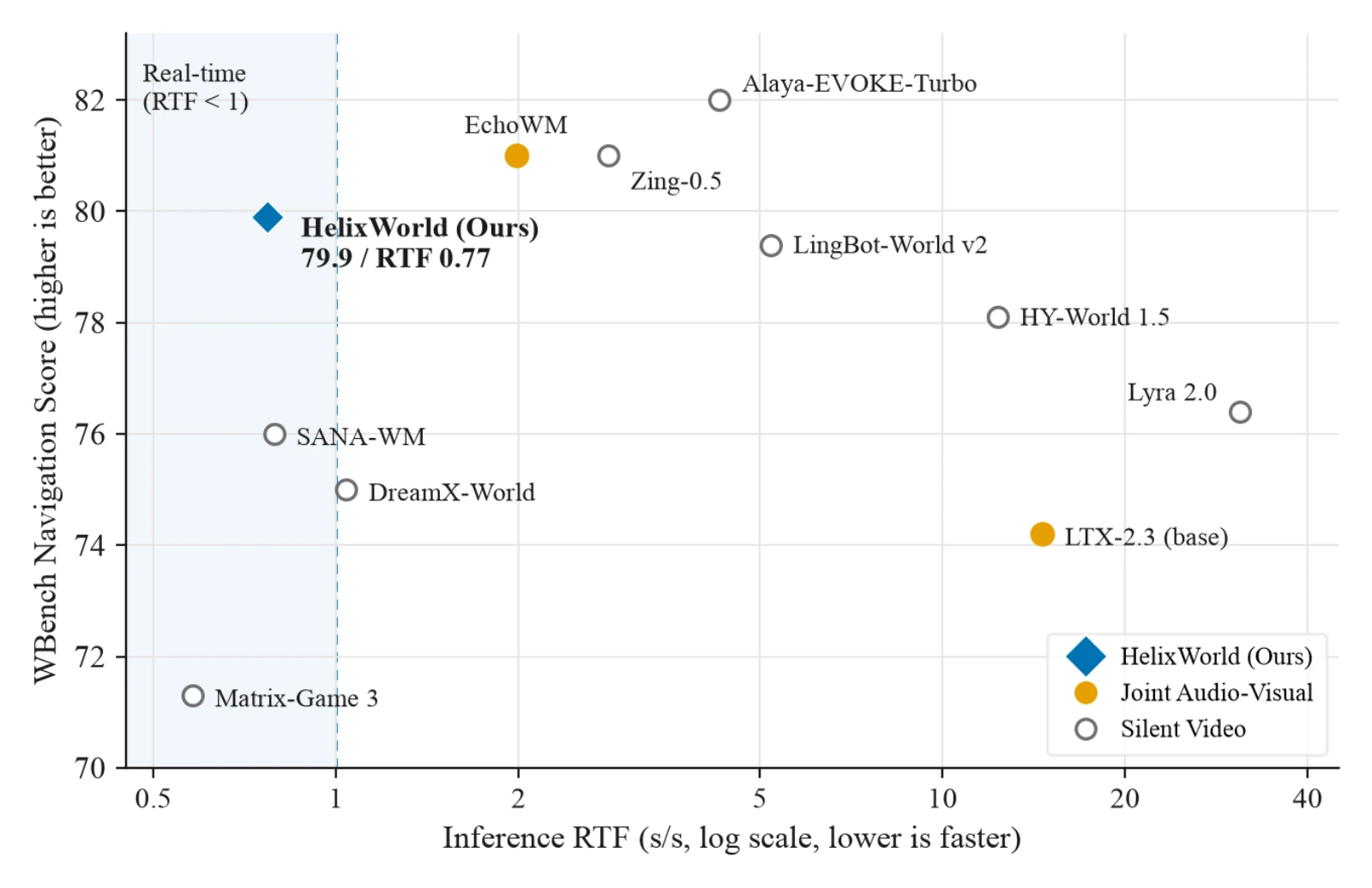
This is the part nobody else had solved. Most “world models” are silent video generators. A few bolt sound on afterward with a separate re-dubbing pass. Helix World treats audio as a native output, locked to what you see and where you are standing. It runs at 24 frames per second on a single NVIDIA H800, with a real-time factor of 0.77 including decode, which means it generates faster than it plays back.
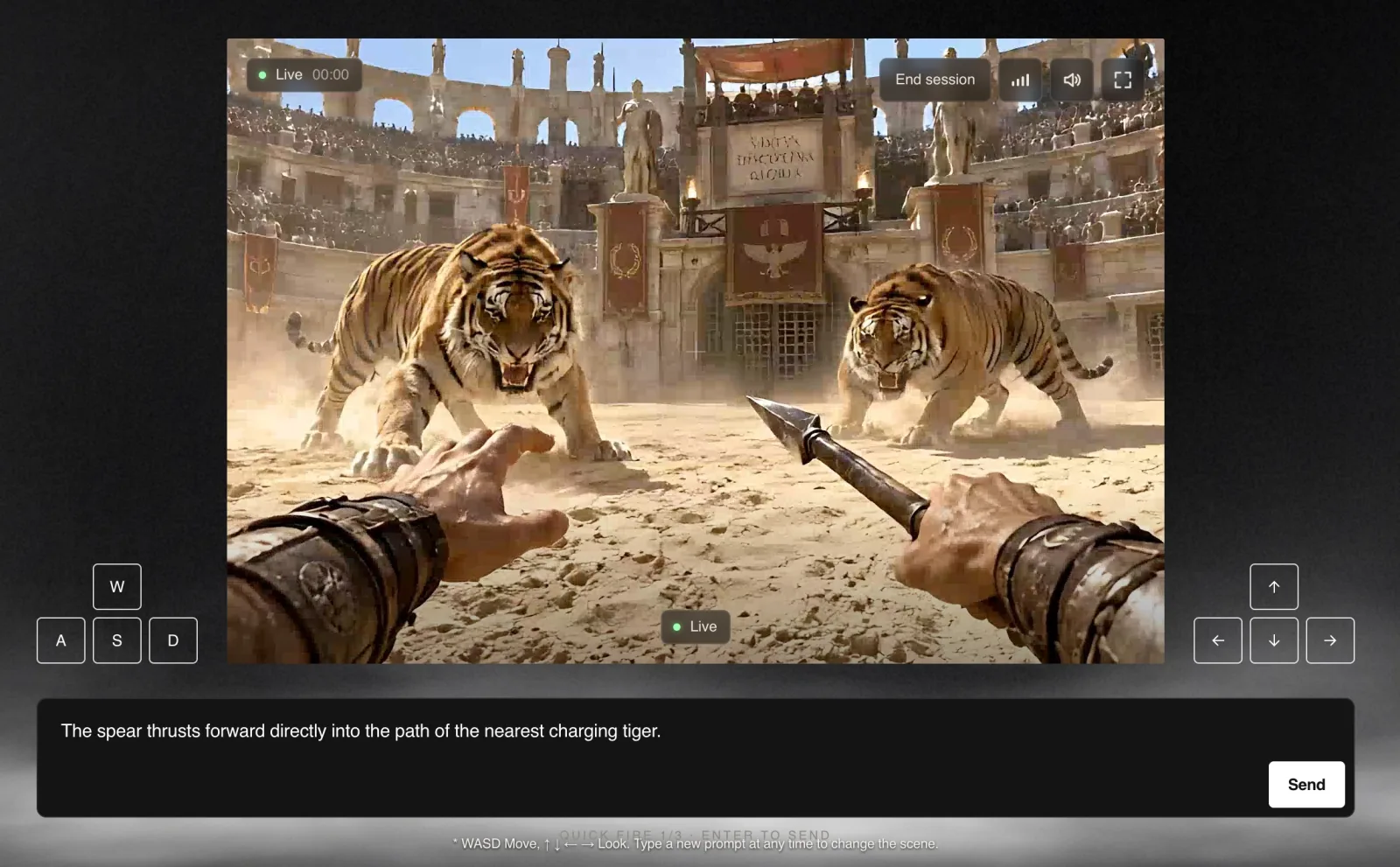
Under the hood, Helix World is built on the open-source LTX-2.3 audio-visual model. The team added 6-DoF camera control and keyboard-action conditioning, then distilled the whole thing into a few-step causal “student” so it can stream chunk by chunk instead of rendering a whole clip at once. It was trained on roughly 3,000 hours of filtered footage, 2.1 million clips, with 48 kHz stereo sound.
Why You Should Care
Sound is half of presence. A generated street that is silent feels like a screensaver. A generated street where footsteps echo off the walls and traffic drifts past on your left feels like a place. For anyone building game prototypes, previz, or immersive scenes, an interactive world that ships its own synchronized ambience is a genuinely new tool, not a prettier demo.
The honest tradeoff: visual quality is a notch below the best silent models. On the WBench navigation split, Helix World scores 79.9 against 82.0 for the top silent model, Alaya-EVOKE-Turbo (which also runs far slower, at RTF 4.29). In a user study with sound on, people preferred Helix World over EchoWM 67.9% to 20.8%. With the sound muted, that flipped and viewers preferred EchoWM. In other words: the audio is the whole point, and it clearly lands.
The team also shipped HelixBench, an audio-visual benchmark of 1,015 human-verified cases across six domains. On spatial-acoustic consistency (does the sound match where things are?), Helix World scores 41.8 versus 12.6 for EchoWM, the only rival in the comparison that generates any sound at all. That gap is the real headline.

Try It / Follow Them
- Live demo: helixworld.org — start from an image and walk around.
- Announcement: Noiz AI blog with videos, benchmarks, and the full method.
- Code: github.com/NoizAI/HelixWorld
- Preview checkpoint: huggingface.co/NoizAI/HelixWorld-preview
IK3D Lab Take
We did not run the checkpoint ourselves, so treat the numbers here as the team’s own, read from their paper and launch post. What we can judge is the direction, and it is the right one. The field has spent two years chasing sharper pixels in silent worlds. Helix World bets that presence comes from the senses working together, and the user study backs that bet.
Where it will break for you: the public release is a preview checkpoint, output is a modest 768×512, and the real-time figures are from an H800 data-center GPU, not the card under your desk. Expect to wait for a consumer-grade build before this becomes a daily tool. If you want it now, the live demo is the fastest way to feel why synchronized sound changes everything. For anyone doing game previz or immersive installations, this is the one to watch, and the HelixBench release means the rest of the field now has to compete on sound too.
How this article was made: researched and drafted with AI assistance, then fact-checked against the original sources and reviewed by Issa before publication.