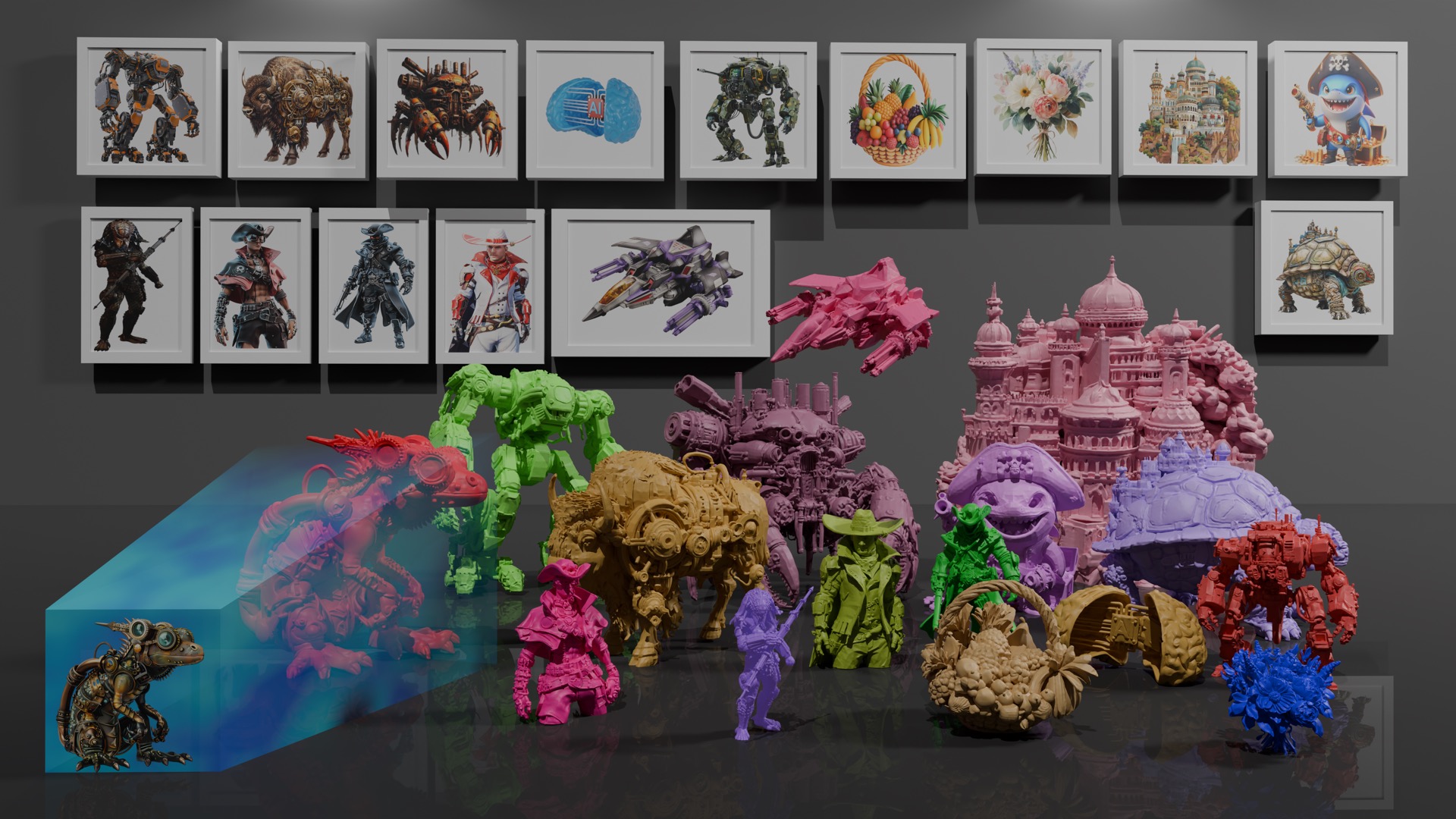
Most image-to-3D models still treat your input photo as a suggestion. They squint at it, extract some features, and hallucinate a shape that’s vaguely in the neighborhood. Pixal3D — accepted to SIGGRAPH 2026 and dropped on GitHub this month under an MIT license — does something refreshingly literal instead: it nails every pixel of your image to an exact point in 3D space. The result is single-image 3D that actually looks like the thing you fed it.
IK3D Lab Take
The race in AI 3D has quietly split in two. One track chases scale — bigger scenes, whole worlds, infinite splats. The other chases fidelity — making the one asset you actually need come out right. Pixal3D is firmly in the second camp, and its “stop guessing, start back-projecting” idea is the kind of clean, fundamental fix that tends to get absorbed into everything downstream. Don’t be surprised if pixel-aligned conditioning shows up in the next Trellis, Tripo, or Rodin release. For now, it’s open, it’s free, and it’s the most faithful single-image 3D we’ve seen. Throw your hardest concept art at it and see what survives.
IK3D Lab Take
The race in AI 3D has quietly split in two. One track chases scale — bigger scenes, whole worlds, infinite splats. The other chases fidelity — making the one asset you actually need come out right. Pixal3D is firmly in the second camp, and its “stop guessing, start back-projecting” idea is the kind of clean, fundamental fix that tends to get absorbed into everything downstream. Don’t be surprised if pixel-aligned conditioning shows up in the next Trellis, Tripo, or Rodin release. For now, it’s open, it’s free, and it’s the most faithful single-image 3D we’ve seen. Throw your hardest concept art at it and see what survives.
Try It / Follow Them
- Code & demo: the TencentARC/Pixal3D repo has the online demo, inference code, and an improved Trellis.2-based build — already past 1,400 stars.
- Paper: arXiv 2605.10922, SIGGRAPH 2026.
- Run it local: if you’ve got an RTX card and a Trellis install, the inference path will feel familiar — it’s the same family of backbone.
IK3D Lab Take
The race in AI 3D has quietly split in two. One track chases scale — bigger scenes, whole worlds, infinite splats. The other chases fidelity — making the one asset you actually need come out right. Pixal3D is firmly in the second camp, and its “stop guessing, start back-projecting” idea is the kind of clean, fundamental fix that tends to get absorbed into everything downstream. Don’t be surprised if pixel-aligned conditioning shows up in the next Trellis, Tripo, or Rodin release. For now, it’s open, it’s free, and it’s the most faithful single-image 3D we’ve seen. Throw your hardest concept art at it and see what survives.
Try It / Follow Them
- Code & demo: the TencentARC/Pixal3D repo has the online demo, inference code, and an improved Trellis.2-based build — already past 1,400 stars.
- Paper: arXiv 2605.10922, SIGGRAPH 2026.
- Run it local: if you’ve got an RTX card and a Trellis install, the inference path will feel familiar — it’s the same family of backbone.
IK3D Lab Take
The race in AI 3D has quietly split in two. One track chases scale — bigger scenes, whole worlds, infinite splats. The other chases fidelity — making the one asset you actually need come out right. Pixal3D is firmly in the second camp, and its “stop guessing, start back-projecting” idea is the kind of clean, fundamental fix that tends to get absorbed into everything downstream. Don’t be surprised if pixel-aligned conditioning shows up in the next Trellis, Tripo, or Rodin release. For now, it’s open, it’s free, and it’s the most faithful single-image 3D we’ve seen. Throw your hardest concept art at it and see what survives.
Why You Should Care
We’ve covered a lot of image-to-3D here in the Lab — Tripo, Rodin, TRELLIS, Seed3D, Step1X-3D. The quality bar keeps rising, but fidelity to the input has been the stubborn ceiling. You’d generate a hero prop from concept art and spend the next hour cleaning up the bits the model improvised. Pixal3D attacks exactly that gap, which makes it interesting for anyone whose input image matters:
- Concept-to-asset pipelines — when art direction approved that design, you want the 3D to match it, not reinterpret it.
- Game and film props — clean geometry and PBR passes mean less retopo and re-texturing before the asset is engine- or render-ready.
- Open and free — MIT license, training code, data prep toolkit, inference code, and an online demo all released. No black box, no per-asset toll.

Try It / Follow Them
- Code & demo: the TencentARC/Pixal3D repo has the online demo, inference code, and an improved Trellis.2-based build — already past 1,400 stars.
- Paper: arXiv 2605.10922, SIGGRAPH 2026.
- Run it local: if you’ve got an RTX card and a Trellis install, the inference path will feel familiar — it’s the same family of backbone.
IK3D Lab Take
The race in AI 3D has quietly split in two. One track chases scale — bigger scenes, whole worlds, infinite splats. The other chases fidelity — making the one asset you actually need come out right. Pixal3D is firmly in the second camp, and its “stop guessing, start back-projecting” idea is the kind of clean, fundamental fix that tends to get absorbed into everything downstream. Don’t be surprised if pixel-aligned conditioning shows up in the next Trellis, Tripo, or Rodin release. For now, it’s open, it’s free, and it’s the most faithful single-image 3D we’ve seen. Throw your hardest concept art at it and see what survives.
Why You Should Care
We’ve covered a lot of image-to-3D here in the Lab — Tripo, Rodin, TRELLIS, Seed3D, Step1X-3D. The quality bar keeps rising, but fidelity to the input has been the stubborn ceiling. You’d generate a hero prop from concept art and spend the next hour cleaning up the bits the model improvised. Pixal3D attacks exactly that gap, which makes it interesting for anyone whose input image matters:
- Concept-to-asset pipelines — when art direction approved that design, you want the 3D to match it, not reinterpret it.
- Game and film props — clean geometry and PBR passes mean less retopo and re-texturing before the asset is engine- or render-ready.
- Open and free — MIT license, training code, data prep toolkit, inference code, and an online demo all released. No black box, no per-asset toll.
Try It / Follow Them
- Code & demo: the TencentARC/Pixal3D repo has the online demo, inference code, and an improved Trellis.2-based build — already past 1,400 stars.
- Paper: arXiv 2605.10922, SIGGRAPH 2026.
- Run it local: if you’ve got an RTX card and a Trellis install, the inference path will feel familiar — it’s the same family of backbone.
IK3D Lab Take
The race in AI 3D has quietly split in two. One track chases scale — bigger scenes, whole worlds, infinite splats. The other chases fidelity — making the one asset you actually need come out right. Pixal3D is firmly in the second camp, and its “stop guessing, start back-projecting” idea is the kind of clean, fundamental fix that tends to get absorbed into everything downstream. Don’t be surprised if pixel-aligned conditioning shows up in the next Trellis, Tripo, or Rodin release. For now, it’s open, it’s free, and it’s the most faithful single-image 3D we’ve seen. Throw your hardest concept art at it and see what survives.
The Story
Pixal3D — short for Pixel-Aligned 3D Generation — comes out of a collaboration between Tencent ARC Lab, Tsinghua University’s BNRist, and Victoria University of Wellington, led by Wang Zhao with Shi-Min Hu as corresponding author (arXiv 2605.10922). It builds on the Trellis.2 and Direct3D-S2 backbones that have been quietly powering the best open 3D generators, but it changes the one thing that’s been holding all of them back.
Here’s the trick. Previous methods inject the input image into the 3D network through attention — a soft, fuzzy “pay some attention to these image features” mechanism. It works, but it’s lossy: fine details get averaged away, and the model fills the gaps with whatever its training prior thinks is plausible. Pixal3D ditches the fuzziness. It explicitly back-projects pixel features into 3D space, establishing a direct pixel-to-3D correspondence. Every visible pixel knows exactly where it lives on the generated surface. Geometry, base color, normals, roughness — all of it stays locked to the source.

The payoff shows up in the details that usually betray AI 3D: crisp edges instead of melted corners, readable surface texture instead of soup, and PBR maps that hold up under a moving light. The team ships base color, normal, and roughness/metallic passes, so what lands in your viewport is a proper materialed asset, not a vertex-colored blob you have to re-texture by hand.
Why You Should Care
We’ve covered a lot of image-to-3D here in the Lab — Tripo, Rodin, TRELLIS, Seed3D, Step1X-3D. The quality bar keeps rising, but fidelity to the input has been the stubborn ceiling. You’d generate a hero prop from concept art and spend the next hour cleaning up the bits the model improvised. Pixal3D attacks exactly that gap, which makes it interesting for anyone whose input image matters:
- Concept-to-asset pipelines — when art direction approved that design, you want the 3D to match it, not reinterpret it.
- Game and film props — clean geometry and PBR passes mean less retopo and re-texturing before the asset is engine- or render-ready.
- Open and free — MIT license, training code, data prep toolkit, inference code, and an online demo all released. No black box, no per-asset toll.
Try It / Follow Them
- Code & demo: the TencentARC/Pixal3D repo has the online demo, inference code, and an improved Trellis.2-based build — already past 1,400 stars.
- Paper: arXiv 2605.10922, SIGGRAPH 2026.
- Run it local: if you’ve got an RTX card and a Trellis install, the inference path will feel familiar — it’s the same family of backbone.
IK3D Lab Take
The race in AI 3D has quietly split in two. One track chases scale — bigger scenes, whole worlds, infinite splats. The other chases fidelity — making the one asset you actually need come out right. Pixal3D is firmly in the second camp, and its “stop guessing, start back-projecting” idea is the kind of clean, fundamental fix that tends to get absorbed into everything downstream. Don’t be surprised if pixel-aligned conditioning shows up in the next Trellis, Tripo, or Rodin release. For now, it’s open, it’s free, and it’s the most faithful single-image 3D we’ve seen. Throw your hardest concept art at it and see what survives.
The Story
Pixal3D — short for Pixel-Aligned 3D Generation — comes out of a collaboration between Tencent ARC Lab, Tsinghua University’s BNRist, and Victoria University of Wellington, led by Wang Zhao with Shi-Min Hu as corresponding author (arXiv 2605.10922). It builds on the Trellis.2 and Direct3D-S2 backbones that have been quietly powering the best open 3D generators, but it changes the one thing that’s been holding all of them back.
Here’s the trick. Previous methods inject the input image into the 3D network through attention — a soft, fuzzy “pay some attention to these image features” mechanism. It works, but it’s lossy: fine details get averaged away, and the model fills the gaps with whatever its training prior thinks is plausible. Pixal3D ditches the fuzziness. It explicitly back-projects pixel features into 3D space, establishing a direct pixel-to-3D correspondence. Every visible pixel knows exactly where it lives on the generated surface. Geometry, base color, normals, roughness — all of it stays locked to the source.
The payoff shows up in the details that usually betray AI 3D: crisp edges instead of melted corners, readable surface texture instead of soup, and PBR maps that hold up under a moving light. The team ships base color, normal, and roughness/metallic passes, so what lands in your viewport is a proper materialed asset, not a vertex-colored blob you have to re-texture by hand.
Why You Should Care
We’ve covered a lot of image-to-3D here in the Lab — Tripo, Rodin, TRELLIS, Seed3D, Step1X-3D. The quality bar keeps rising, but fidelity to the input has been the stubborn ceiling. You’d generate a hero prop from concept art and spend the next hour cleaning up the bits the model improvised. Pixal3D attacks exactly that gap, which makes it interesting for anyone whose input image matters:
- Concept-to-asset pipelines — when art direction approved that design, you want the 3D to match it, not reinterpret it.
- Game and film props — clean geometry and PBR passes mean less retopo and re-texturing before the asset is engine- or render-ready.
- Open and free — MIT license, training code, data prep toolkit, inference code, and an online demo all released. No black box, no per-asset toll.
Try It / Follow Them
- Code & demo: the TencentARC/Pixal3D repo has the online demo, inference code, and an improved Trellis.2-based build — already past 1,400 stars.
- Paper: arXiv 2605.10922, SIGGRAPH 2026.
- Run it local: if you’ve got an RTX card and a Trellis install, the inference path will feel familiar — it’s the same family of backbone.
IK3D Lab Take
The race in AI 3D has quietly split in two. One track chases scale — bigger scenes, whole worlds, infinite splats. The other chases fidelity — making the one asset you actually need come out right. Pixal3D is firmly in the second camp, and its “stop guessing, start back-projecting” idea is the kind of clean, fundamental fix that tends to get absorbed into everything downstream. Don’t be surprised if pixel-aligned conditioning shows up in the next Trellis, Tripo, or Rodin release. For now, it’s open, it’s free, and it’s the most faithful single-image 3D we’ve seen. Throw your hardest concept art at it and see what survives.