NVIDIA dropped vkSplatting 2026.1 straight into Jensen Huang’s GTC keynote — and it’s not a tech demo. It’s an Apache 2.0 reference implementation that finally lets Gaussian Splatting behave like a proper renderable scene format: instanced meshes, multiple lights, ray-traced shadows, deferred shading, and DLSS Ray Reconstruction stacked on top. If you’ve been waiting for splats to grow up and join the rest of your real-time pipeline, this is the release.
The Story
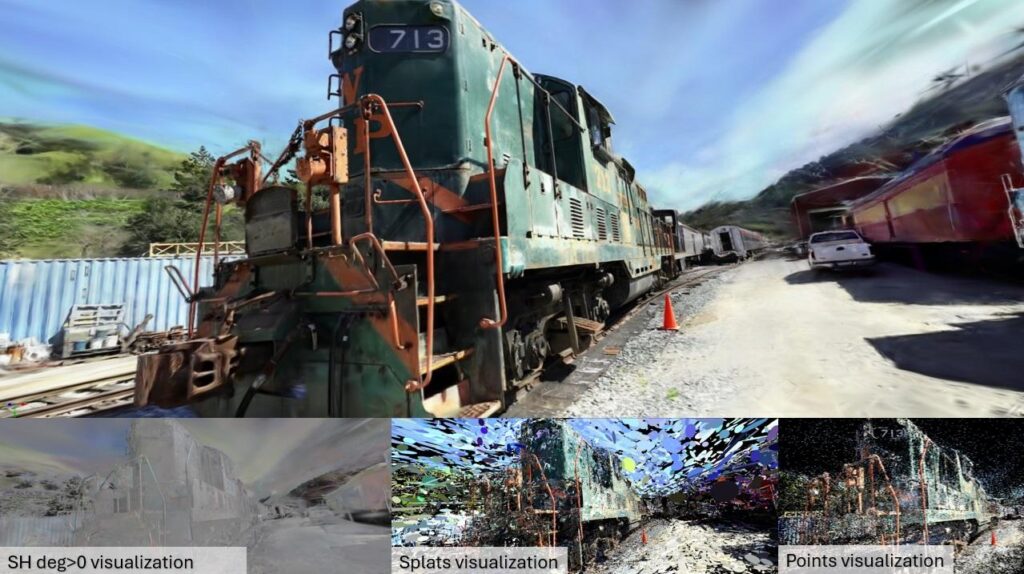
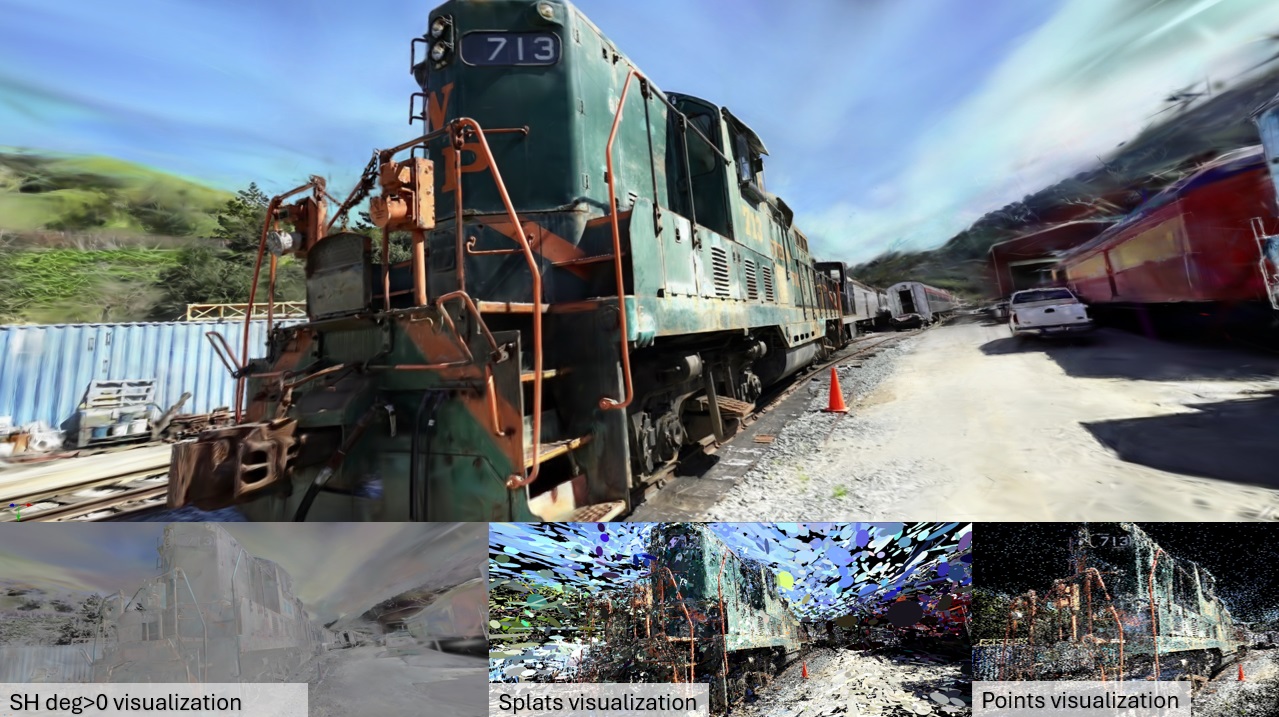
vkSplatting started life as a humble Vulkan reference viewer in NVIDIA’s nvpro-samples repo — a way for engine devs to study fast, GPU-accelerated 3DGS rasterization without reverse-engineering closed players. The 2026.1 update, which Michael Rubloff at Radiance Fields covered when it appeared during GTC, basically rewrites the architecture from “viewer” into “renderer.”
The headline change is multi-instance splat sets. Until now, every splat scene was a single flattened blob — load it, sort it, render it, dispose of it. 2026.1 introduces global index tables and unified sorting across multiple splat assets, so a row of identical window frames or a forest of identical trees gets defined once and instanced everywhere. Memory drops, sort cost drops, and you can finally compose splat scenes the way game engines compose mesh scenes.
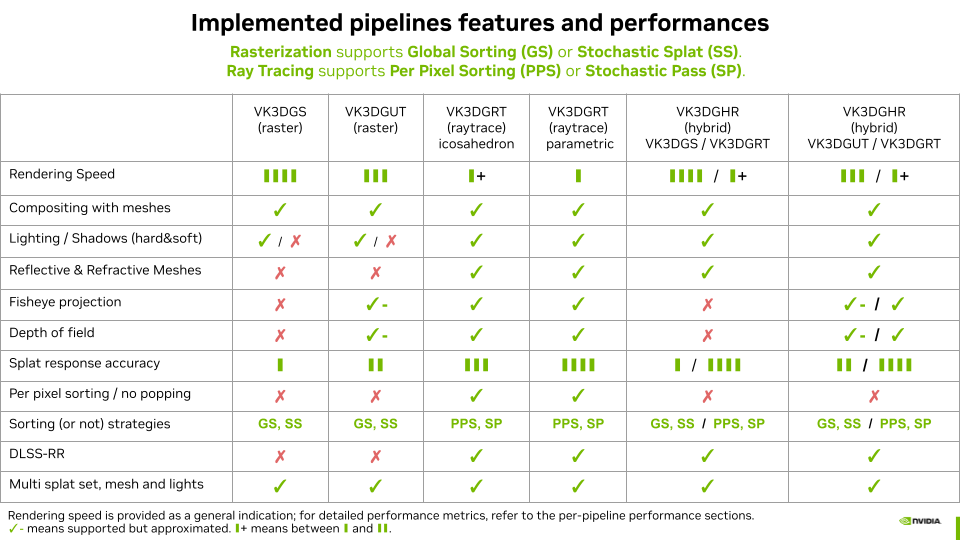
Stacked on top of that: a centralized bindless asset system with a root scene buffer (so the GPU sees the whole scene without per-draw rebinds), front-to-back rasterization with depth consolidation and deferred shading for splats (yes, you read that right — G-buffer style splats), multi-TLAS / BLAS chunking with VRAM budget checks before allocation, and stochastic splat sorting with Monte Carlo tracing for probabilistic effects.
Why You Should Care
Two things have been blocking 3DGS from going from “gorgeous capture format” to “production scene format.” First: shadows. Splats look amazing in static turntables, but the moment you tried to put a splat tree in a real scene with a moving sun, the shading lied. 2026.1 ships multi-light support — point, spot, directional — with hard and soft ray-traced shadows, denoised and upscaled by DLSS Ray Reconstruction. That’s the same RR pipeline that’s making path-traced games playable. Now it’s eating splats for breakfast.
Second: composability. A splat capture has been a one-shot — beautiful, but isolated. Multi-instance + bindless means you can build a scene out of splat assets the way you build a scene out of GLB files. Drop in a captured statue ten times around a captured plaza and pay (almost) nothing extra. This is the architectural unlock that makes splat-native level design actually viable.
The fact that this drops as Apache 2.0 open source on the nvpro-samples GitHub is the real headline for engine builders. Cesium, Niantic Spatial, OTOY, Otoy, Spline, Unity-side splat plugins — they all now have an industrial-strength reference for instancing, RT shadows, and deferred splat shading. Expect the entire ecosystem to converge on this within a quarter.
Try It
- GitHub: nvpro-samples/vk_gaussian_splatting — clone, build, drop in a PLY or SOG, and you’re rendering with RT shadows in minutes if you have an RTX card.
- Deep dive on the original release: NVIDIA Technical Blog — vk_gaussian_splatting.
- 2026.1 changelog & visuals: Radiance Fields — NVIDIA Releases Vulkan Gaussian Splatting 2026.1.
- Built-in tools: transform editor, infinite grid, image comparison with MSE / PSNR / FLIP — handy for benchmarking your own scenes against ground truth.
IK3D Lab Take
2026 is the year splats stopped being a captured asset and started being a render target. OctaneRender made them path-traceable. Photoshop made them editable. OpenUSD and glTF made them shippable. Now NVIDIA is handing every engine the reference code for instanced, ray-shadowed, DLSS-RR-denoised splat rendering — Apache 2.0, no strings.
If you’re building anything that touches real-time 3D — a viewer, a plugin, a custom engine, a WebGPU experiment — vkSplatting 2026.1 is the codebase to read this month. The architecture choices in here (multi-instance, deferred splats, stochastic sort) are going to be the playbook for the next three years of 3DGS rendering. Get it on your GPU before everyone else copies the homework.