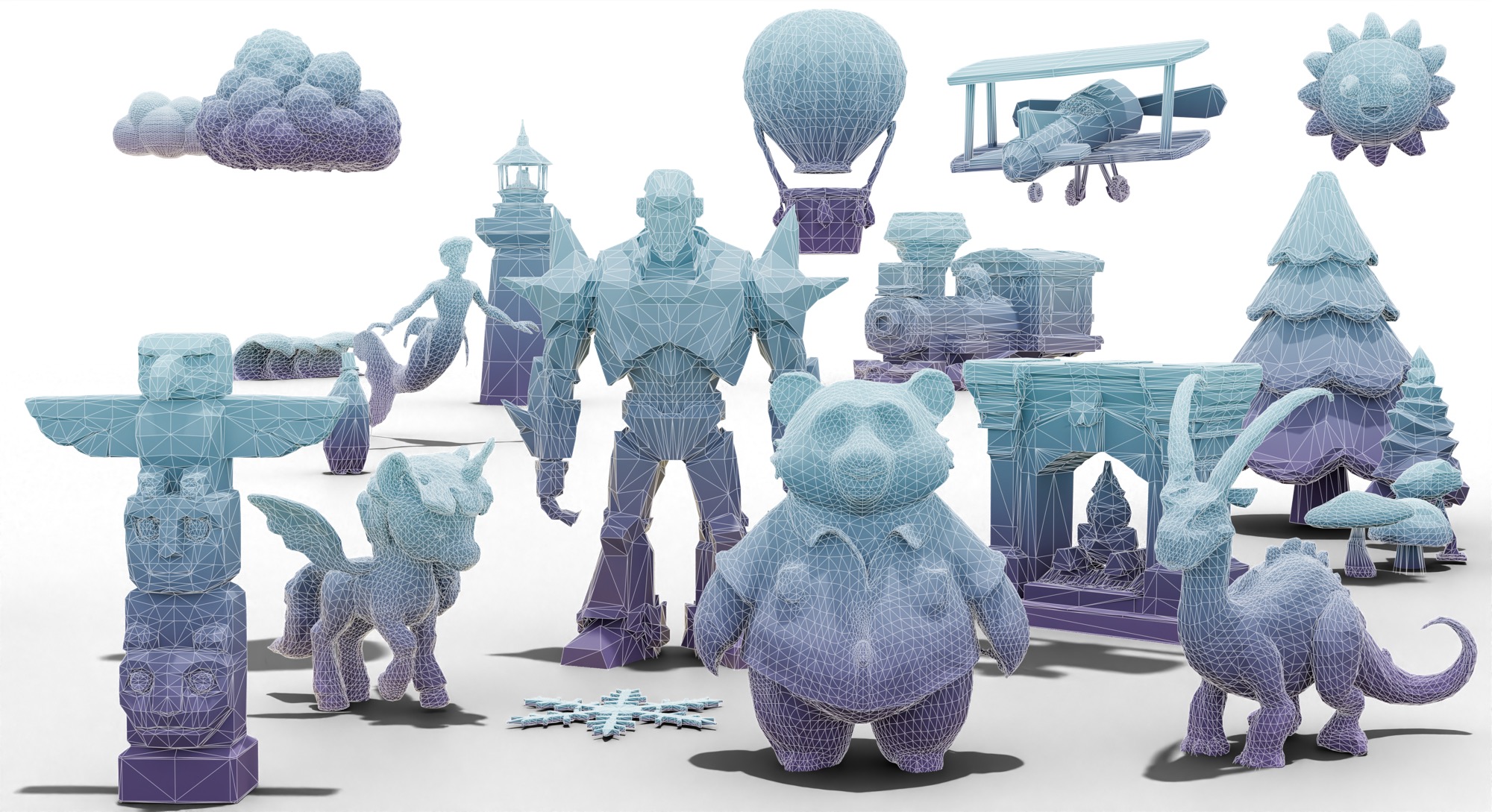
Every 3D artist who has run an AI generator has met the same monster: you type a prompt, you get a shape that looks right in the render — and then you open the wireframe and recoil. It’s a chaotic soup of a million triangles, riddled with holes, floating shards, and edges that flow like spilled spaghetti. Unusable for animation, punishing to retopologize, impossible to edit. That gap — between “looks 3D” and “is actually a usable mesh” — is the real unsolved problem of AI 3D. A December 2025 paper called MeshRipple, from a team including Matthias Nießner, just took the sharpest swing yet at closing it.
The Story
Almost every AI 3D tool you’ve used — Tripo, Rodin, Meshy, Hunyuan3D — splits the job in two. A diffusion model dreams up the overall shape as a dense point cloud or volume, then a separate step marches a surface over it. The result is a dense mesh: geometrically faithful, but with hundreds of thousands of uniform triangles and zero regard for how a human would actually build the model. It’s the 3D equivalent of a photo of handwriting versus an editable text file.
A different family of models tries to generate the mesh the way an artist would: face by face, as a sequence — an “artist-mesh.” This is the autoregressive approach behind MeshAnything, DeepMesh, BPT and others, and when it works, the output is a lean, clean model with a few thousand well-placed polygons. The catch, as the MeshRipple authors put it bluntly, is that serializing a 3D surface into a 1D token stream “breaks long-range geometric dependencies, producing holes and fragmented components.” The model forgets what it built 5,000 tokens ago, so the far side of the mesh never quite connects to the near side. You get beautiful topology with a gaping hole in the back of the head.
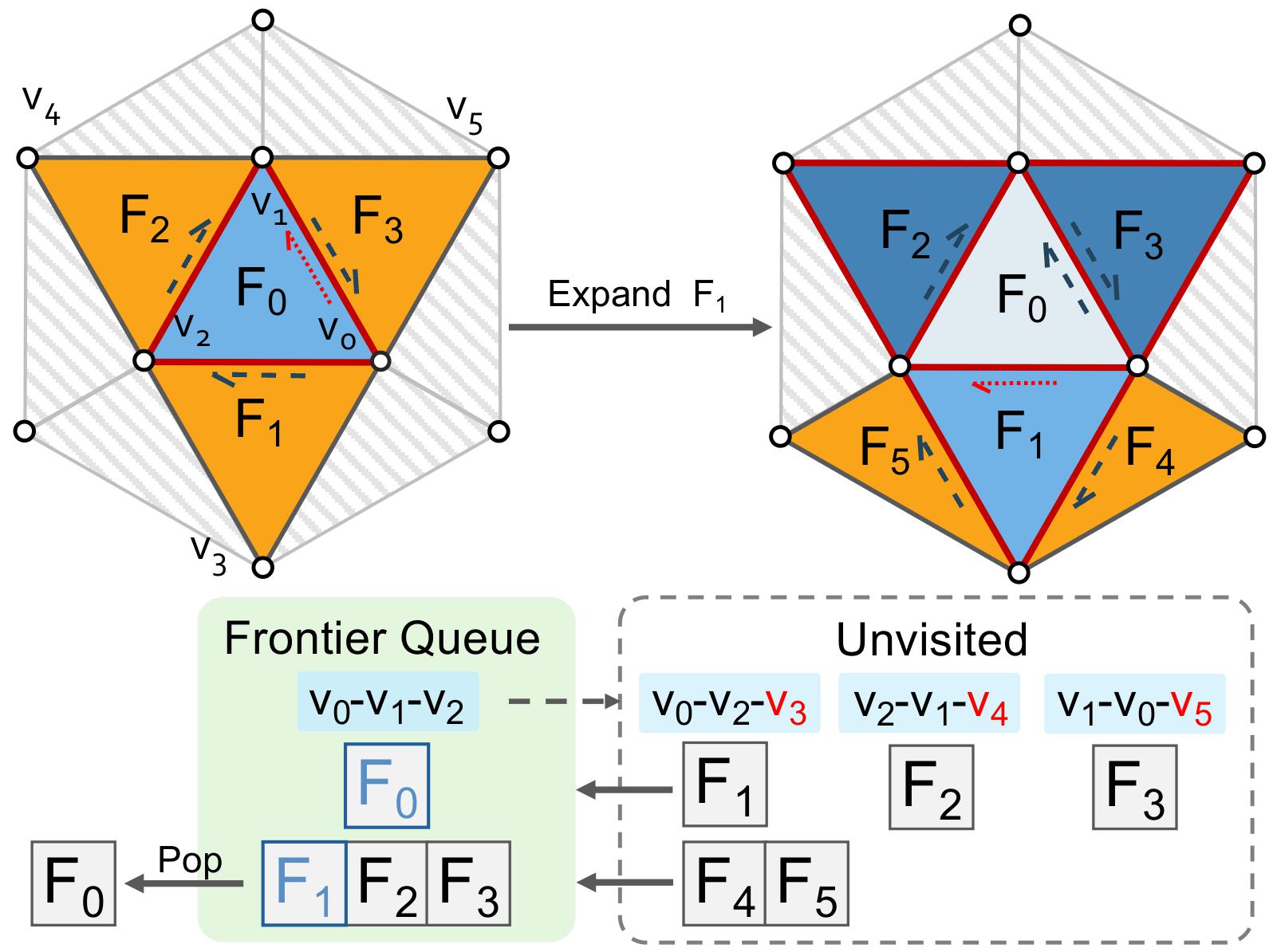
MeshRipple’s fix is elegant enough to describe in one image: instead of scanning faces in some arbitrary order, it grows the mesh outward from an active frontier, like a ripple spreading across the surface of a pond. Three ideas make that work. A frontier-aware BFS tokenization orders the faces so that generation always follows the actual surface topology — neighbors stay neighbors. An expansive prediction strategy keeps the growing edge coherent and connected instead of letting it splinter. And a sparse-attention global memory gives the transformer an “effectively unbounded receptive field,” so it can remember the whole mesh and resolve those long-range connections that used to snap.
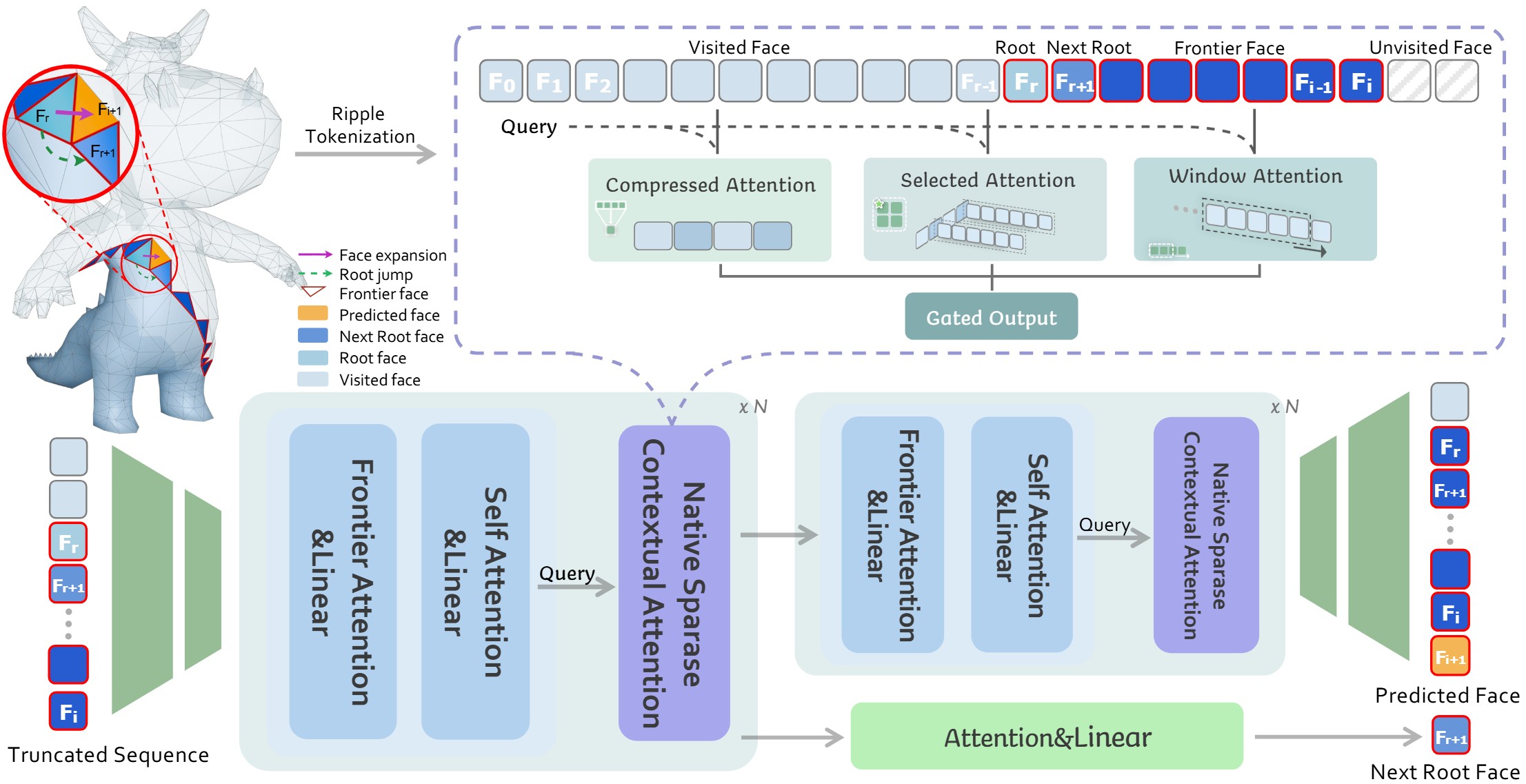
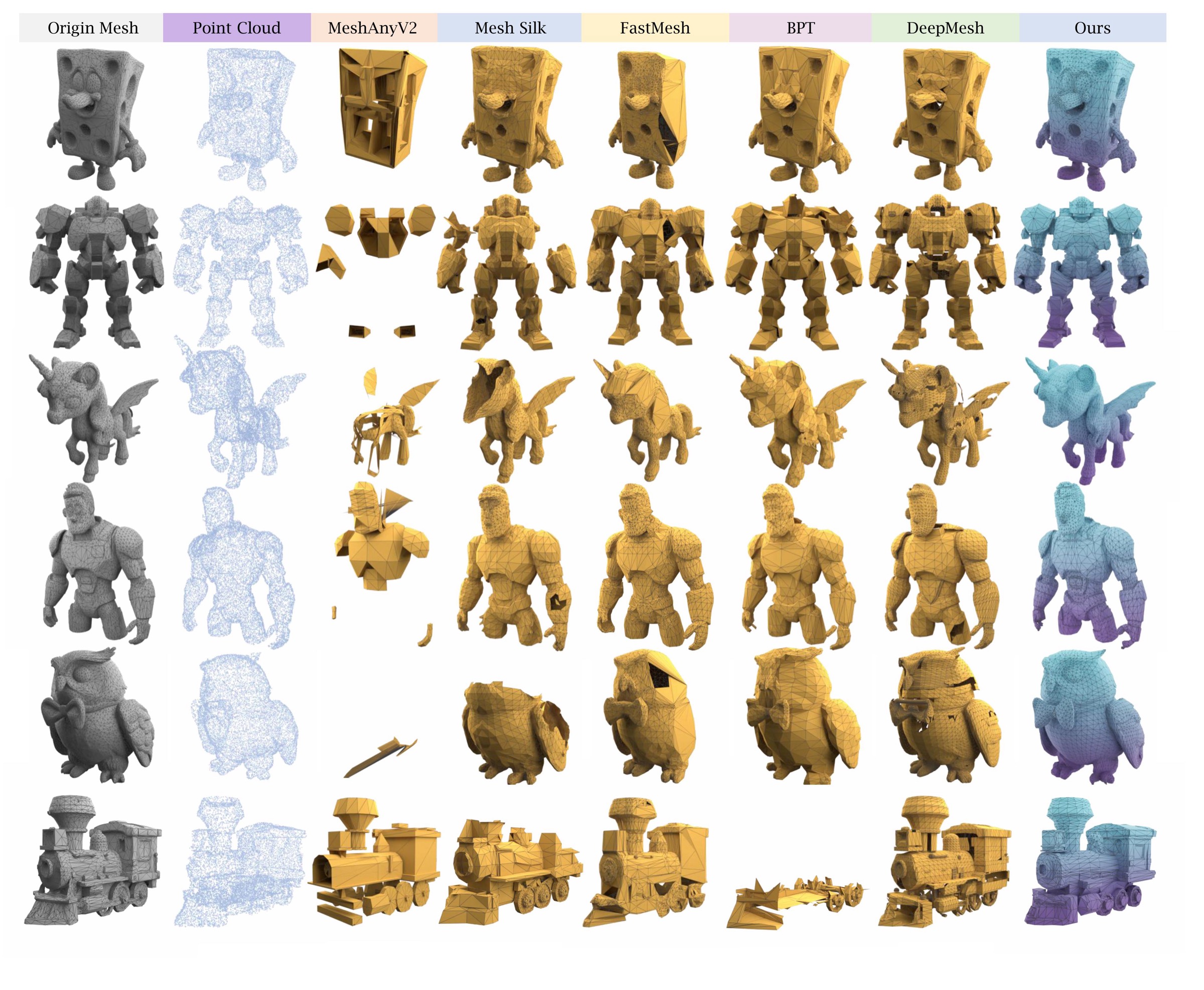
The payoff shows up on the benchmarks. Across both artist-mesh and dense-mesh tests, MeshRipple reports higher surface fidelity and topological completeness than a wall of strong 2025 baselines — DeepMesh, MeshAnything v2, BPT, FastMesh and Mesh Silksong — producing more complete, connected geometry rather than fragmented shells. It even scales up to large multi-object rooms without falling apart, the exact regime where sequence-based generators historically collapse.
Why You Should Care
Topology is the difference between a prop you can drop into a game and a prop you have to rebuild. Clean, connected edge flow is what lets a character deform when it’s rigged, what makes UV unwrapping sane, what keeps a subdivision surface from crumpling. Every hour an AI generator saves you on blocking gets eaten back — and then some — if you have to retopologize a 400,000-triangle blob by hand. Solve topology, and AI 3D finally slots into a real production pipeline instead of sitting in the concept-art sandbox.
And MeshRipple isn’t alone — it’s the loudest voice in a chorus. 2026 has quietly become the year of the artist-mesh: QuadGPT generates native quadrilateral meshes with clean edge flow instead of merging triangles after the fact; QuadLink pushes quad-dominant output via point-relation learning; Strips as Tokens (SATO) tokenizes meshes as strips and segments UV charts during generation. The research field has collectively decided that “geometrically correct” isn’t good enough — the mesh has to be buildable. That’s the shift that matters for anyone who actually opens the wireframe.
Try It / Follow Them
MeshRipple is a research release right now, not a one-click app. Start with the project page — the ripple-growth videos alone make the idea click — and the arXiv paper (2512.07514) for the full method. If you want to feel the topology problem yourself today, generate an asset in a shipping artist-mesh tool and inspect the wireframe: Tripo’s and Rodin’s quad-topology modes, or the open Hunyuan3D line, are the closest production analogues. Watching for code drops from the MeshRipple, QuadGPT and SATO teams is the fastest way to see when this jumps from paper to pipeline.
IK3D Lab Take
The splat wave taught AI to capture the world; the world-model wave taught it to dream one. MeshRipple is part of a quieter, less glamorous wave that might matter more to working 3D artists than either: teaching AI to build geometry the way we actually build it — connected, editable, clean. The “ripple” metaphor is almost too on the nose, but it’s the right one. Real modeling isn’t a scan of independent points; it’s a surface that grows outward, each face aware of its neighbors. The moment an AI generator hands you a mesh you’d have been proud to model yourself — not a soup you have to launder — is the moment text-to-3D stops being a toy. On the evidence here, that moment is close.