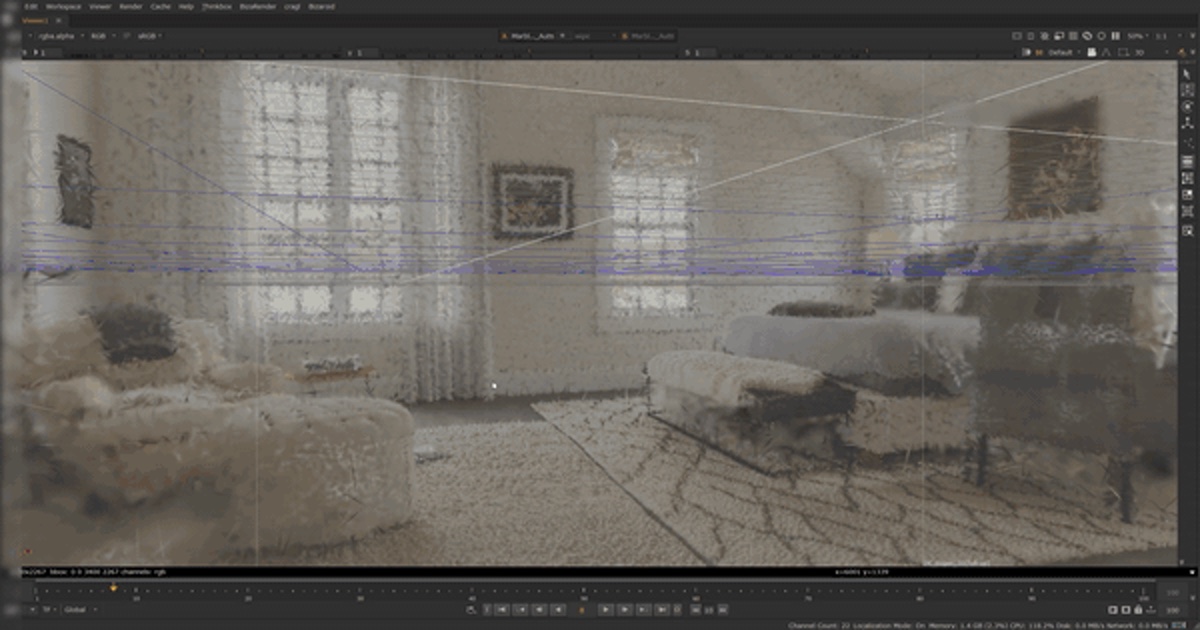
One person, a weekend, and an MIT licence just did something Foundry, Autodesk and every VFX vendor on earth has been circling for two years: put a generative AI world model inside the compositing app. Patrick Crucke’s Marble x Nuke takes a text prompt or a still frame, sends it to World Labs’ Marble API, and drops the resulting Gaussian splats straight into Nuke’s 3D viewport as a PLY. No bridge app. No export dance. And it works on Nuke Non-Commercial, which means it costs you exactly nothing to try tonight.
The Story
We covered Marble when World Labs threw open its doors at the start of the month — Fei-Fei Li’s spatial intelligence bet, speak a place into existence, get splats back. Great tech. Slightly awkward reality: it lived in a browser. You generated a world, downloaded an SPZ, converted it, imported it somewhere, and by then the creative thought that started the whole thing had gone cold.
Crucke’s toolset is four Python nodes that collapse that entire loop into the node graph:
- Marble T2W — text-to-world. Describe a scene, get a 3D world.
- Marble I2W — image-to-world. Single image, multi-image, or full reconstruction from up to four views with azimuth control.
- Marble List — browse, manage and delete the worlds you’ve generated.
- Marble Splats — download the splats and auto-create a
GeoImportnode.
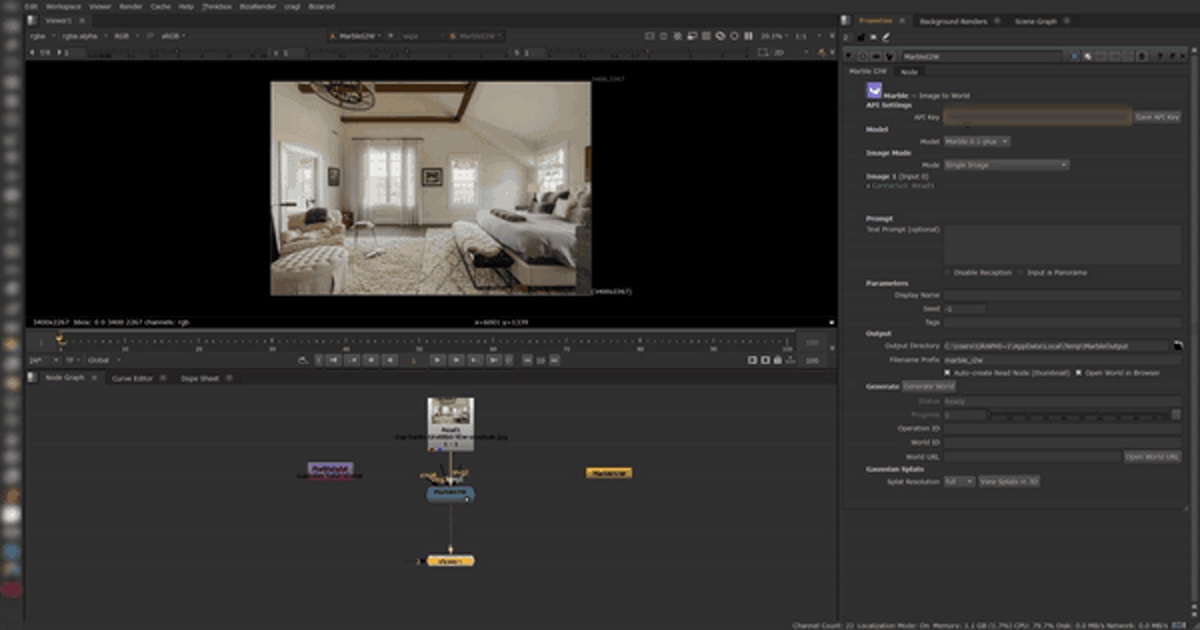
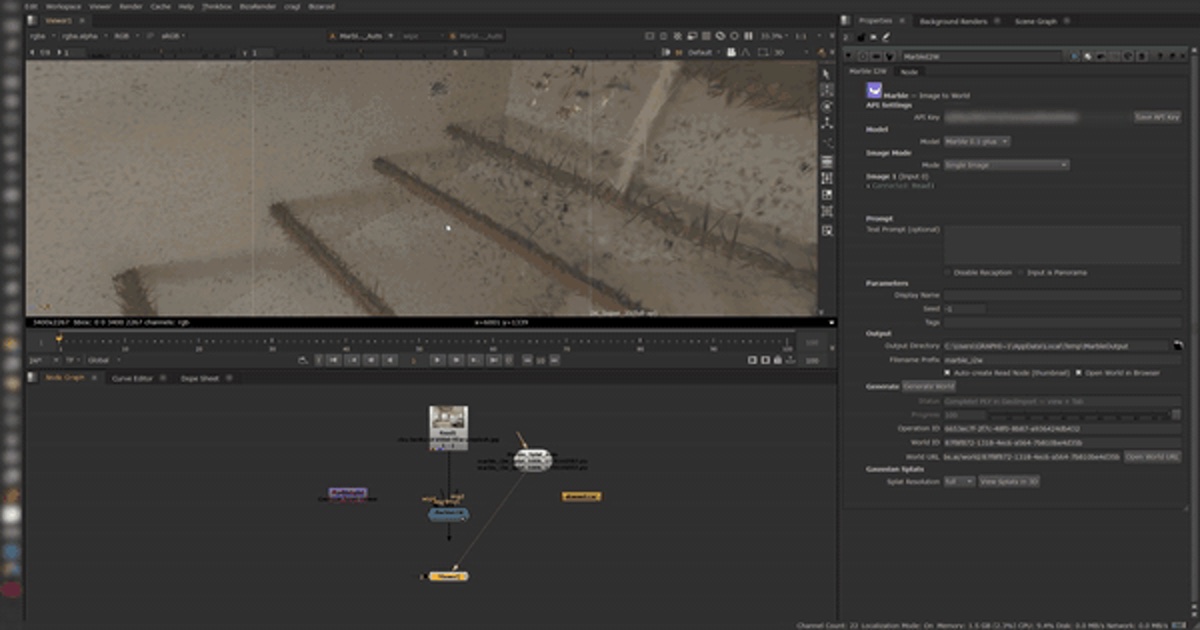
The detail that gives it away as artist-built rather than demo-built: after generation it auto-creates the GeoImport node for you. Select it, press V, then Tab, and you’re flying through the world. There’s also a built-in SPZ→PLY converter with no external Python packages required — which, if you’ve ever tried to pip-install anything into a locked-down studio Nuke, is the single most thoughtful line in the whole repo.
Why You Should Care
Set extensions, previs environments and 3D backplates are some of the most expensive slow work in the pipeline. The classic route is shoot it, scan it, or model it. Marble x Nuke offers a fourth: prompt it, and have a navigable splat world in the viewer in under a minute — one you can project onto, frame up, and composite against without ever opening a DCC.
Be honest about what it is, though. Gaussian splats are not meshes. You can’t relight them conventionally, they don’t hold up if you walk too far from the generated viewpoint, and Marble’s output is a plausible world rather than a measured one. This is a previs, concept and backplate tool, not a set-survey replacement. Treated as such, it’s genuinely fast.
The bigger signal is where this sits in the week’s news. Houdini 22 just shipped native Gaussian splats as generally available. D5 Render 3.1 added ray-traced splatting. Nuke 17 opened up a 3D viewport good enough that a solo developer could bolt a world model onto it in Python. Splats have stopped being a research curiosity and become plumbing — and the interesting work has moved to who wires them into which app first. Increasingly, that’s one motivated artist with an API key, not a vendor roadmap.
Try It / Follow Them
- Get it: github.com/NXStorm/Marble-x-Nuke — MIT licensed, or grab it from Nukepedia.
- Install: copy the
MarbleXnuke/folder into your.nukedirectory and register it ininit.py. That’s it. - You’ll need: Nuke 17.0+ (Commercial, Indie or Non-Commercial — all work) and a free World Labs API key from platform.worldlabs.ai. Your key is stored locally.
- Commercial use: the MIT licence covers the plugin code only. Generated worlds fall under World Labs’ terms and need an eligible plan.
- Follow the author: Patrick Crucke posts AI × VFX pipeline tools and breakdowns on LinkedIn.
IK3D Lab Take
We keep writing about billion-dollar labs shipping world models, and it’s easy to read that as a story about compute. It isn’t. Marble was already impressive on 2 July. What changed on 15 July is that somebody put it three keystrokes from a compositor’s hands — and the gap between “impressive model” and “tool I actually use” turned out to be four Python nodes and a format converter.
That’s the pattern worth internalising if you build in this space. The foundation models are becoming commodity APIs. The scarce, valuable, deeply human skill is knowing exactly where in a real artist’s workflow the friction lives, and deleting it. Crucke knew that pressing V then Tab is how a Nuke artist enters 3D, so the tool leaves you one keystroke away. No lab in California was going to ship that detail.
Install it on Non-Commercial tonight. Prompt a room. Fly through it. Then ask yourself which app you use every day that’s still missing its four nodes.