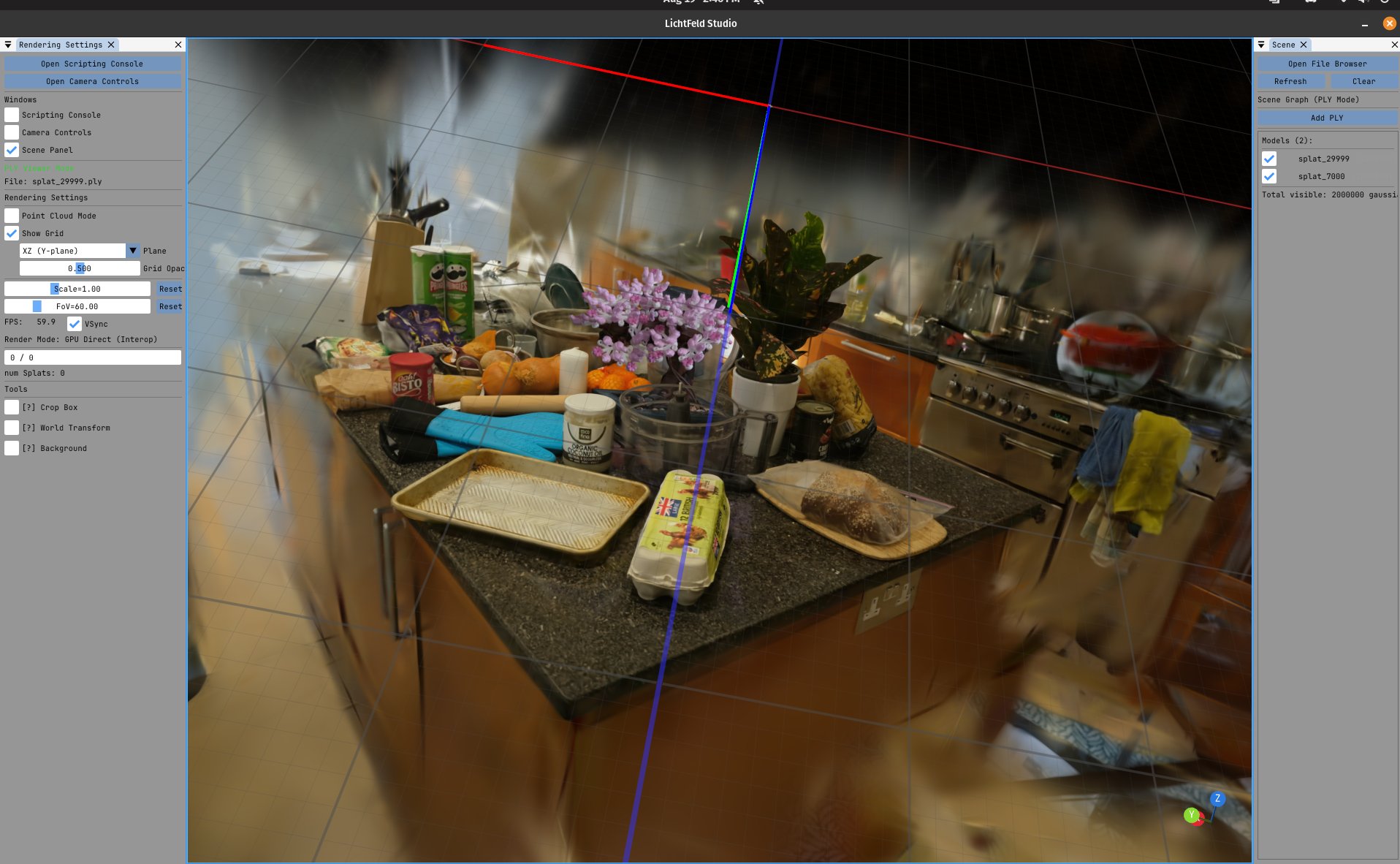
We have covered a dozen ways to get a Gaussian splat into your DCC of choice — Blender, Houdini, Nuke, Octane, Photoshop. But almost all of them assume the splat already exists, cooked somewhere else in the cloud. LichtFeld Studio is the outlier: a single free, open-source desktop app that trains the splat, edits it, and renders it — no subscription, no upload, no round-trip. And on July 1, 2026 it shipped v0.5.3, tearing out its entire legacy rendering stack in favour of one clean Vulkan path.
The Story
LichtFeld Studio is the work of MrNeRF (researcher Janusch Patas, the person behind the community bible Awesome 3D Gaussian Splatting), now backed by German studio Core11 GmbH and radiance-field outfit Volinga. It is licensed GPL-3.0. You can build it from source for free, or grab a one-click binary for $30 to skip the compile. It runs on Windows and Linux.
What makes it different from the pile of standalone splat viewers (NVIDIA’s vkSplatting, VulkanSplatting, SplatStream) is that it is a studio, not a renderer. The recent v0.5 release turned it into a genuine platform: a built-in plugin architecture powered by an embedded Python runtime — each plugin gets its own isolated uv environment, hot-reloads on save, and can reach right into the app’s internal state. The UI was rebuilt on top of RmlUI, so the whole interface is themeable with plain HTML and CSS concepts instead of hand-drawn immediate-mode widgets. It also learned to render meshes alongside splats, shipped OpenMesh Python bindings, and added Mesh2Splat to convert a polygon asset into Gaussians on the spot.
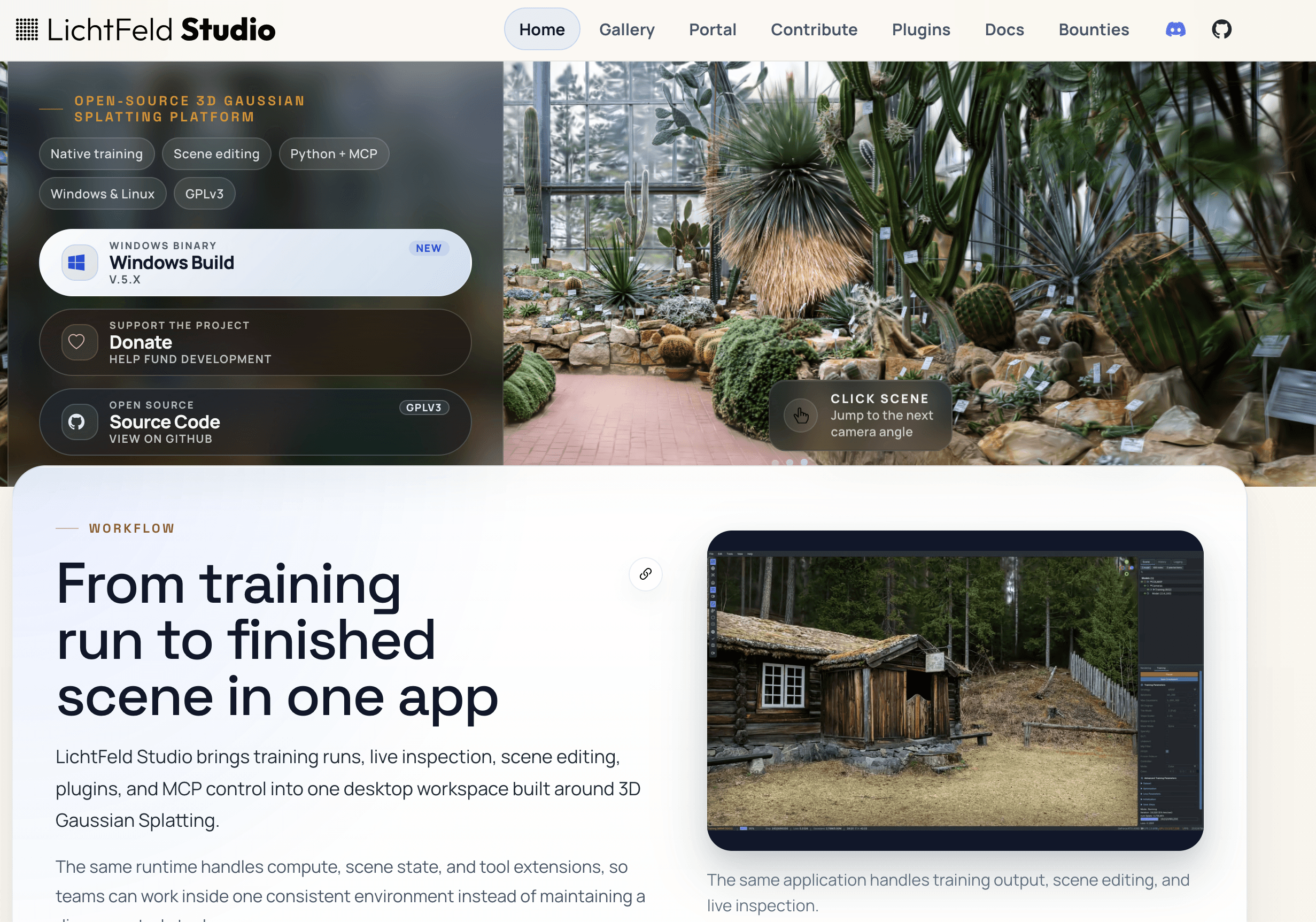
Then came v0.5.3 — the housekeeping release that turned out to be the important one. It removed OpenGL and the CUDA renderer entirely, standing up Vulkan as the single render path through the fastgs vksplat rasterizer. Training stays on CUDA, connected to the Vulkan viewer through a shared buffer, so you watch the splat sharpen live as it optimizes. The same drop added an Asset Manager for browsing and importing splats, RAD file export that plugs straight into World Labs’ LOD streaming pipeline, 8K-resolution training, a spherical/equirectangular camera model in the COLMAP loader, a quantized Adam optimizer that cuts training VRAM, and a live VRAM/performance HUD.
Why You Should Care
Two words buried in the feature list matter more than the Vulkan rewrite: MCP support. LichtFeld Studio speaks the Model Context Protocol — the same standard Claude uses to reach into Blender, SketchUp and Fusion. That means an AI agent can drive the whole radiance-field pipeline programmatically: kick off a training run, crop the scene, swap a background, export the result, all through tool calls instead of mouse clicks. Pair that with the Python plugin marketplace and the full undo/redo stack that plugin actions hook into, and you have a splat studio that is scriptable and agent-controllable end to end — for free, on your own GPU.
The RAD export is the other quiet flex. It means a splat you trained locally in an open-source tool can feed directly into World Labs’ streaming stack — the same Marble ecosystem Fei-Fei Li’s team is building the commercial world-model business on. Open trainer, industrial pipeline, one .rad file between them.
Try It / Follow Them
- Get it: source and releases on GitHub, or the one-click Windows/Linux binary from lichtfeld.io ($30, optional).
- What you need: an NVIDIA GPU for training (CUDA); the Vulkan viewer handles rendering. Feed it a COLMAP dataset — including 360°/equirectangular captures now.
- Go deeper: the plugin docs, Bounties board and Discord are all linked from the site if you want to write your own Python tools or claim a dev bounty.
- Follow: MrNeRF on X and the Radiance Fields coverage for release notes.
IK3D Lab Take
Most of the splatting news we cover is a big vendor bolting 3DGS onto an existing product. LichtFeld Studio is the opposite trajectory — a community project that quietly became the most complete open-source splat pipeline there is, then wired itself for AI agents before most of the paid tools did. The Vulkan rewrite is the boring, correct kind of engineering that makes everything after it faster. But the MCP hook is the part we will be poking at: a free, local, agent-drivable radiance-field studio is exactly the kind of tool that turns “I read about splats” into “I trained one last night.” Download it, point it at a folder of phone photos, and watch the scene assemble itself. That is the whole pitch, and it costs nothing to test.