Here is a talking head that invents every single pixel of its own face, 25 times a second, on one GPU. No pre-recorded loop, no mouth swap glued onto a video clip. And it is the first one you can download, weights and all, for free. Meet AVTR-1.
The Story
Most “AI avatars” cheat. They record a real person once, then paste a freshly generated mouth over the old footage. It looks fine until the head needs to turn, or react, or just sit and listen. AVTR-1, from the team at Avaturn, throws that approach out.
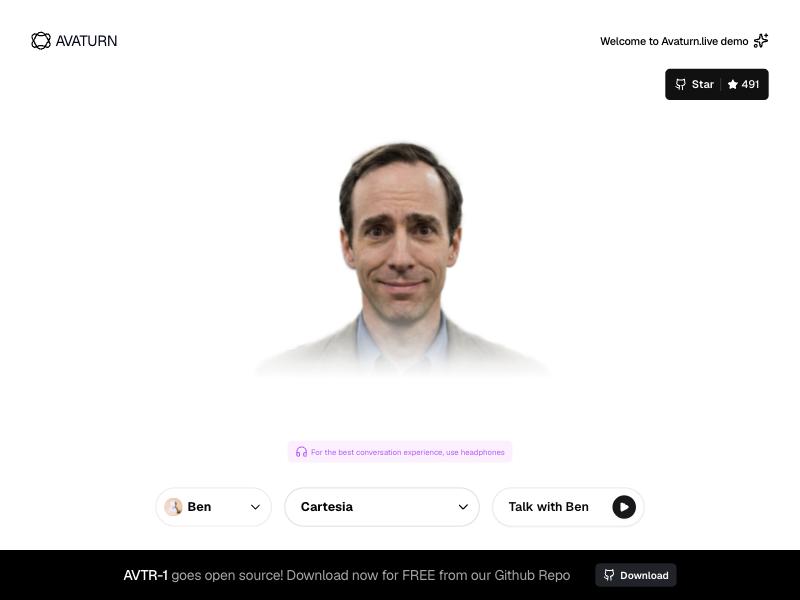
You hand it one portrait photo and an audio stream. From there it paints the whole face, frame by frame, in real time. It is a flow-matching autoregressive model — it predicts short 5-frame chunks of motion and keeps going, so the avatar never runs out of a loop to fall back on. The result is lip-sync, head motion, blinks and micro-expressions, all synthesized on the fly.
The headline trick is in the project’s own tagline: “Avatars that listen back.” AVTR-1 takes a dual audio stream — the avatar’s speech and your voice. So while you talk, the face reacts: it nods, it holds eye contact, it does the small human things a listener does. That is full-duplex conversation, not a one-way video player.
Why You Should Care
Real-time talking-head models are not new. Real-time talking-head models you can actually run on your own machine, with open weights, are basically non-existent — until this one. That is the whole point.
The performance numbers are the part that will make you sit up:
- 25 fps on a single GPU, with sub-200ms latency per 5-frame chunk — fast enough to feel like a real conversation.
- L40: 2.4× real-time. A100: 2.2×. Even an RTX 4060 Ti clears real-time at 1.2×.
- The floor is roughly an RTX 4060 (0.86×, ~232ms) — a consumer card, not a datacenter rig.
For creative technologists that opens real doors: AI-driven NPCs and digital humans that run locally, interactive installations that react to a visitor, virtual presenters, VTuber-style characters driven from a single still. And because it is open, you can study the architecture, fine-tune it, or wire it into your own pipeline instead of renting someone’s API.
Be honest about the limits, though. This is a head-and-shoulders model, not a full body. It needs Linux, an NVIDIA card (Ampere or newer), CUDA 12.x and TensorRT. And the license is split three ways: the core model ships under a community license (free commercial use under $10M revenue), but the renderer and streamer backends are PolyForm Noncommercial. So a commercial product needs you to bring your own rendering layer — the brain is open, part of the plumbing is not.

Try It / Follow Them
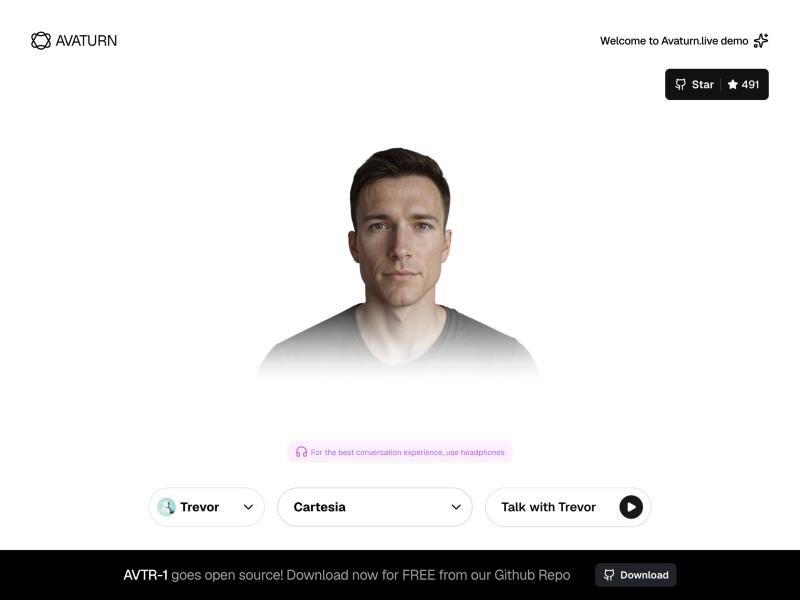
- Talk to it right now (no sign-up): avaturn.live/demo. Pick Ben, Jane or Trevor, pick a voice, hit talk. Headphones recommended.
- Code: github.com/avaturn-live/avtr-1 — clone,
pixi install, download the weights, build the TensorRT engines, run the interactive demo. - Weights: huggingface.co/avaturn-live/avtr-1 (gated — request access).
- Managed API, if you’d rather not self-host: avaturn.live.
IK3D Lab Take
We’ve watched text-to-3D, world models and Gaussian splats go open over the past year. AVTR-1 brings that same open-weights wave to the one place it was conspicuously missing: the live, reactive human face. The “listens back” part is what makes it feel different — a face that only talks is a video; a face that reacts while you talk is a presence.
It is not a magic full-body digital human, and the split license means you’ll do some engineering before you ship anything commercial. But the fact that this runs on a 4060 at real time, with weights you can hold, is the kind of quiet milestone that looks obvious in hindsight. Go talk to Ben for two minutes. The uncanny part isn’t that he speaks — it’s the moment he’s just listening to you.




Incredible article! Testing out the live demo and seeing the avatar react and hold eye contact while listening is genuinely mind-blowing. It really feels like the start of a new era for interactive AI characters. Thanks for sharing this breakdown